
Why assess dispersion after graphite milling?
The measured particle distribution depends partly on whether agglomerates remain intact. A milling comparison needs a consistent analytical preparation and measurement method.
Graphite plays a vital role as an electrode material in batteries, fuel cells, capacitors, and numerous industrial applications such as lubricants, conductive coatings, and composites. In battery technology, graphite particle size is a key determinant of battery capacity, cycle life, rate capability, and overall performance. Optimizing particle size and distribution is therefore critical for battery design and manufacturing.
This joint report combines the expertise of Retsch, Microtrac, and Sugino to provide a comprehensive overview of graphite grinding, dispersion, and particle size analysis - supporting a deeper understanding of the entire process chain from milling and dispersion to analytical evaluation.
Part 1 - Precise Milling with Retsch High Energy Ball Mills
Ball milling is a proven method for reducing hard, brittle materials from <10 mm to the micrometer scale. For graphite, the process is challenging due to its lubricating properties, which can cause grinding balls to slide rather than provide impact situations. Therefore, a successful milling requires careful selection of ball size, jar size, and speed.
LEARN MORE
Ball Milling Principle
In a ball mill the sample material is placed together with the balls in a closed jar and then moved with high speed. The statistical movement of the balls results in an effective size reduction mechanism characterized by high-frequency impact forces and intensive friction. Particle size reduction depends on the milling parameters like jar size, ball size, jar filling situation, movement pattern, frequency and material properties of the sample.
Key Strategies for Graphite Ball Milling
A standard dry ball milling process applied on graphite is described in the text box on the bottom of this page. To achieve best grinding results of graphite samples and to shorten the grinding time or to obtain fine particles, some key approaches can be applied.
Pre-crushing in Another Mill: Large particles of graphite > 10 mm can be pre- crushed for example in a Retsch Jaw Crusher or Retsch Rotor Beater Mill. With this method particle size already below 1 mm can be obtained. The sample material can then be further processed in a ball mill.
Stepwise Grinding in a Ball Mill: Perform for example two or more steps of grinding using progressively smaller balls in every step. Balls should be at least three times larger than the largest graphite particles of the sample material. The final particle size is typically reduced to 1/100 of the ball diameter.
Wet Grinding: To obtain small graphite particles e.g. < 20 µm, wet grinding with solvents like water or alcohol is required. In a wet grinding process agglomeration is prevented and fine particles are achieved by friction forces. Water cooling is useful to reduce or avoid grinding breaks to cool down the sample material.
Advanced High Energy Laboratory Ball Mills: High energy laboratory ball mills, such as Mixer Mills or the Emax, deliver the finest results in shortest time.
A Standard Dry Ball Milling Applied on Graphite
For dry grinding of graphite, the Planetary Ball Mill PM 400, equipped with 4 x 250 ml tungsten carbide jars and 3 mm grinding balls, is operated at 280 rpm. The 4 jars are filled one-third with balls and one-third with sample, so that in total, 300 ml of graphite powder is processed in this setup. In a grinding time of 10 h, consisting of milling cycles with 15-minute cooling breaks after every 15 minutes of operation, the graphite powder with an initial particle size of 50 µm is reduced to d90 = 18 µm.
Grinding Tools
▶ 4 x 250 ml jars made of WC
▶ Ø 3 mm grinding balls made of WC
Sample Material
▶ graphite powder
▶ 4 x 30 g
▶ 280 rpm
▶ 10 hours (total time)
▶ d90 = 50 µm initial particle size
▶ 15 min of grinding + 15 min of cooling
d90 = 18 µm
Example: Wet Ball Milling
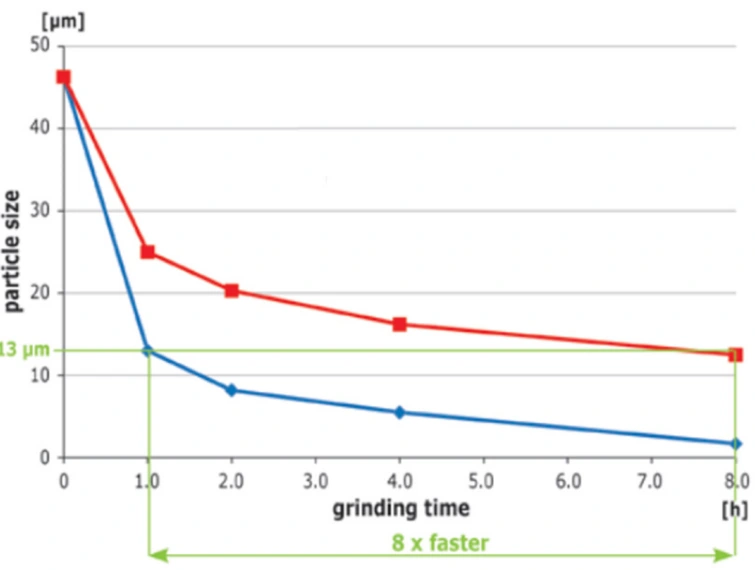
Using the high-energy laboratory ball mill Emax, graphite can be ground to particle sizes below 10 µm in just 2 hours through a wet grinding process. For this, 50 ml zirconia jars are loaded with 5 g sample, 110 g zirconia balls of 0.1 mm diameter and 13 ml isopropanol. The graphite material of a starting particle size d90 = 50 µm was reduced to 13 µm already after 1 h of grinding. In comparison, with a Planetary Ball Mill PM 100 the same result of 13 µm is reached after 8 h. The Emax’s high efficiency is achieved through its unique jar movement, high energy input at 2,000 rpm, and efficient water cooling, which enables continuous operation and superior fineness compared to planetary ball milling.
Grinding Tools
Planetary Ball Mill PM 100
High Energy Ball Mill Emax
Grinding Tools
▶ 500 ml jar made of ZrO2 ▶ Ø 1 mm grinding balls
made of ZrO2
Sample Material
▶ graphite powder ▶ 30 g ▶ d90 = 50 µm initial particle size ▶ 130 ml Isopropanol
▶ 450 rpm
▶ 8 hours
▶ 2,000 rpm
▶ 8 hours
▶ cooling breaks every 15 min
▶ automatic cooling break
▶ 50 ml jar made of ZrO2 ▶ Ø 1 mm grinding balls
made of ZrO2
Sample Material
▶ graphite powder ▶ 5 g ▶ d90 = 50 µm initial particle size ▶ 13 ml Isopropanol
Part 2 - Efficient Dispersion with Sugino Star Burst Mini
High-pressure homogenization offers an advanced, contamination-minimizing approach for dispersing, emulsifying, grinding, and exfoliating raw materials including graphite. The Sugino Star Burst system uses high-pressure waterjet to generate intense shear and impact forces, enabling efficient exfoliation and delamination (shown in Figure 3).
Wet Jet Milling Principle
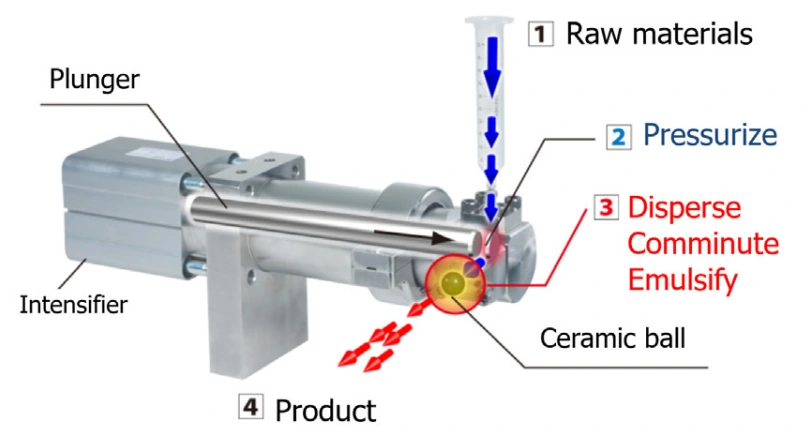
The functional principle of Wet Jet Milling is shown in Figure 2.
Raw material slurry or emulsion is pressurized by an intensifier up to 2,450 bar.
LEARN MORE
Pressurized material is discharged from the diamond nozzle in the interaction chamber.
The discharged jet flow collides with the ceramic ball, and the material is dispersed, emulsified, or exfoliated.
Star Burst Product Lineup
Sugino Machine Limited develops and manufactures a wide range of precision machines and systems for industrial production. Among their innovative product lines is the Star Burst series, which offers advanced wet pulverization and dispersion solutions. Star Burst devices are used in various industries, and this wet milling method is scalable, making it suitable for both laboratory and industrial-scale production.
Star Burst Mini is a laboratory-scale device that ensures a uniform dispersion of materials in the solvents with a minimum volume of samples. Enhanced maintainability and simplified process line enable researchers to efficiently screen samples and quickly clean the process line.
Dispersion
Emulsification
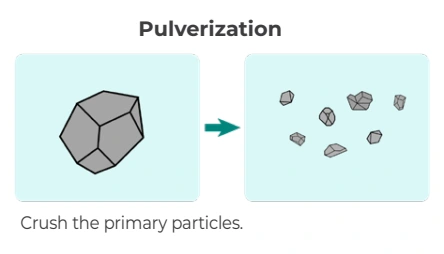
Pulverization
Exfoliation
Example: Dispersion
Commercial available synthetic graphite material with an initial particle size of 27 µm is processed by Star Burst Mini (HJP-25001CE). Graphite powder was suspended in solvent/dispersant (DISPERBYK-192) and mixed in a PP bottle. The 10 wt% graphite slurry was then processed on 30 passes (cycles) at 2,450 bar using water and at 1,500 bar using 2-propanol. The workflow is described in Figure 4.
Process workflow and pictures of the wet milling example.
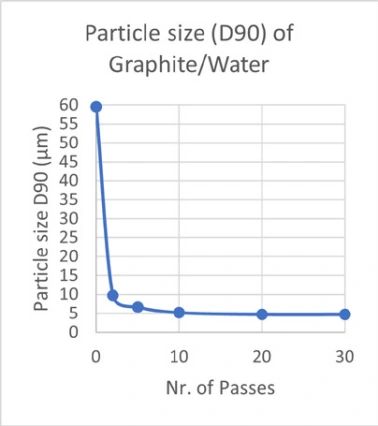
Particle sizes of graphite slurry in both water and 2-propanol were measured at multiple intervals during processing to assess the effect of repeated passes on size reduction. The comparison demonstrates that the most significant decrease in particle size occurs within the initial 10 passes, with minimal further reduction observed afterward. The particle size after 30 passes became d90= 5 µm from around 27 µm of raw material for both water-based and alcohol-based slurry. Particle size of graphite became faster smaller in water than that in 2-propanol. Probably it is because water’s high surface tension produces strong cavitation forces and also additional mechanical damage may occur by higher pressure processing. Additional details on particle size distribution can be found in part 3 of this paper.
LEARN MORE
Part 3 - Particle Size Analaysis with Microtrac Sync
Accurate particle size analysis is essential for quality control and process optimization. The Microtrac SYNC Laser Diffraction Particle Size Analyser measures materials from 0.01 µm to 2,000 µm, using three lasers to capture a full angular range of light scattering. This enables precise measurement of both small and large particles in a single cycle. Dynamic image analysis can also be integrated for additional shape and morphology data.
Principle of Digital Image Analysis and Laser Diffraction
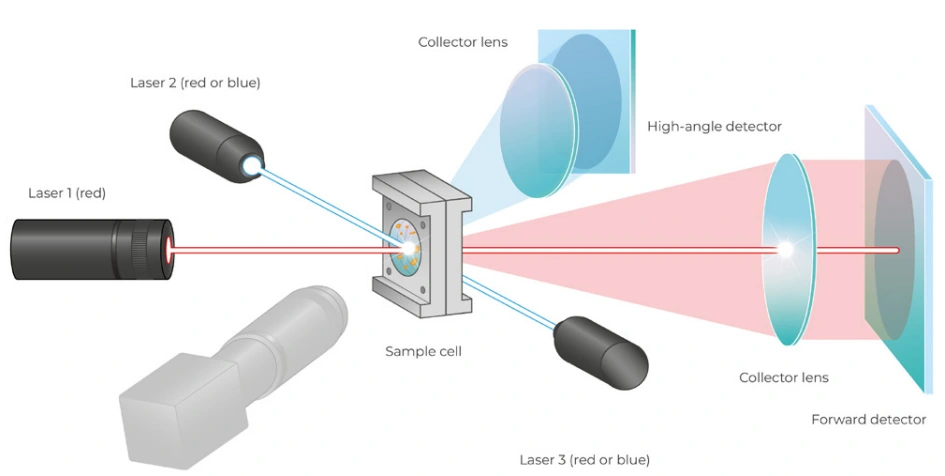
Laser diffraction determines particle size by analyzing the angular pattern of scattered light: larger particles scatter light at smaller angles, while smaller particles scatter at wider angles. The SYNC system utilizes three lasers positioned at different angles to the sample and sequentially scans the scatter patterns on multiple detectors. This approach enables accurate measurement of both small and large particles within the same measurement cycle. The SYNC has the capability to add Dynamic Image Analysis functionality to provide shape and morphological information to the dataset by analysing individual images of the sample.
Product Lineup, Camsizer and Sync
For over 50 years, Microtrac has been a pioneer in the design, manufacture and supply of particle size and shape instrumentation. The Microtrac SYNC is the latest generation of Laser Diffraction Particle Size Analysers measuring size ranges from 0.01 microns to 2,000 microns. The addition of Dynamic Image Analysis to the SYNC expands the range to 4,000 microns as well as adding a wealth of information about the shape and morphology of the particle sample. The Camsizer is a dedicated Dynamic Image Analyser that expands the range from below a micron into the millimetre range employing a patented two camera system. The SYNC and Camsizer can measure in both wet and dry modes. For nanomaterials, the Nanotrac FLEX utilizes the principle of Dynamic Light Scattering to determine particle sizes in the nano range of 0.3 nanometeres to approximately 6.5 microns. Particle charge or zeta-potential can be measured using the Microtrac Stabino. Stability and shelf life of dispersions can be determined using the Microtrac Turbiscan range. Wet or dry, large or small – Microtrac offers a suite of instrumentation for Particle Characterization.
Example: Particle Size Analysis
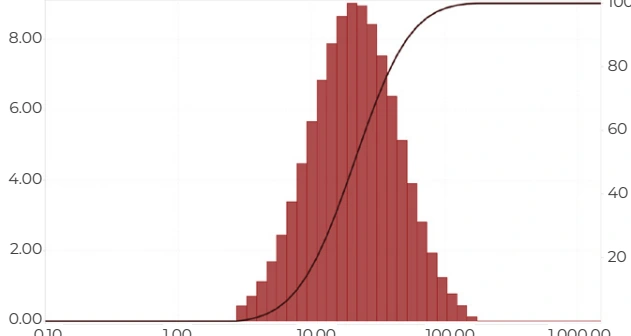
For analysing the particle size of the wet jet milling experiment, the laser diffraction measurement method was used. Samples were processed through the Star Burst Mini and analyzed on the SYNC system after a specific numbers of passes. The material was dispersed in a beaker of water, stirred and subjected to one minute of ultrasonic energy at 50W. Sample was transferred to the to the SYNC using the FlowSync module by pipette. The correct concentration was determined using the automatic “loading” feature of the SYNC Dimensions software. For this measurement a flow rate of 60% was used. The instrument uses MIE compensation to calculate the effects of extraeneous scattered light due to the transparency of the particles. In this case, a refractive index of 2.00 was used to ensure correct MIE compensation. The comparison shows the base dispersion prior to processing in the Star Burst Mini. The initial analysis exhibited a mean particle size of 27.44 microns, with a range extending from just over 1 micron to slightly above 100 microns at the coarse end.
l e n n a h C %
g n i s s a P %
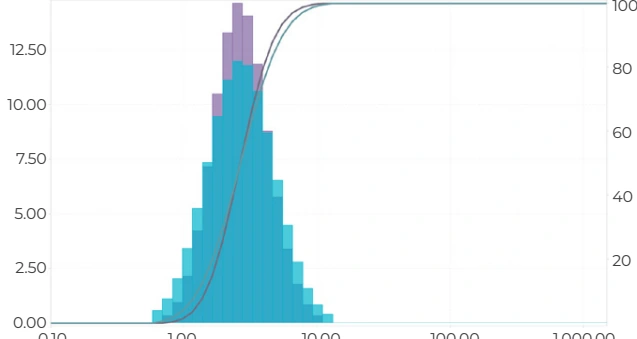
After two passes of dispersion, the material was measured again; Figure 8 displays a significant reduction in particle size, with the mean now at 6.53 microns. Further processing up to 30 passes did not result in significant additional reduction in particle size. These results indicate that 10 passes with the Star Burst Mini are sufficient to reduce graphite to its smallest particle size under these conditions.
l e n n a h C %
g n i s s a P %
l e n n a h C %
g n i s s a P %
Conclusion
To obtain fine or ultra-fine graphite powders, different sizing methods can be employed, including ball milling and jet milling technology. Ball milling, using systems such as those from Retsch, is commonly used in laboratories for flexible, small-scale sample processing and process optimization, while jet milling, as offered by Sugino, provides an approach for dispersion with minimal contamination. When starting from larger graphite particles, jaw crusher or rotor mills can be used to pre-crush the sample material for further processing. Precise characterization of particle size and, where relevant, particle shape is essential for quality control, process optimization, and understanding the influence of morphology on performance. Technologies such as laser diffraction from Microtrac provide comprehensive analysis. The combination of products offered from Retsch, Sugino and Microtrac fully enable manufacturers to tailor specific graphite powders for optimal performance in batteries or other high-value applications.
How can a laboratory distinguish graphite milling from dispersion effects?
Distinguish the milling stage from dispersion and analytical evaluation. A particle-size result obtained under one dispersion condition may not describe the same agglomerate state as another. Record preparation conditions and the measurement method together when comparing graphite batches or development trials.
| Consideration | Information to provide |
|---|---|
| Graphite feed | Form and initial distribution |
| Milling objective | Reduction or material modification |
| Measurement | Dispersion method and distribution basis |
Discuss material testing with Glen Mills or Contact Glen Mills for information or a quote.