
How can a laboratory assess metal powder recovered after printing?
Sieve the recovered powder to separate agglomerates, then test the fraction intended for reuse against the build specification. A sieve classifies particles by passage through an opening. It cannot establish their shape or chemical composition.
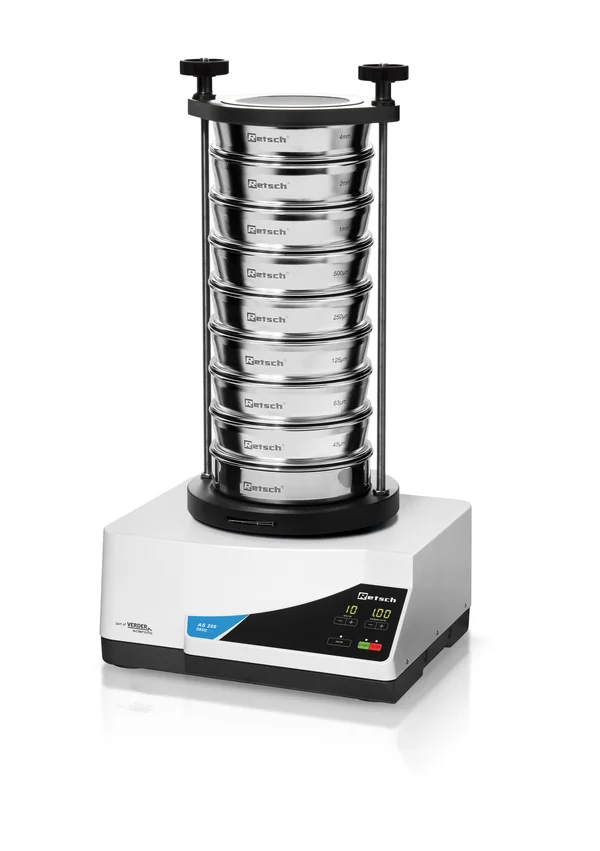
For example, the RETSCH AS 200 basic separates excess powder into size fractions after printing. Record the sieve openings, the mass recovered in each fraction and the powder lot so that the separation can be traced back to the material considered for reuse. Dynamic image analysis can distinguish irregular particles in a size fraction when particle shape matters to the next build.
Planning metal powder analysis
Describe the powder’s composition and process history alongside the intended measurement. Separating an existing distribution and changing that distribution are different operations. Keep the original condition, preparation steps and result together so that a later quality decision is based on what the method actually examined.
What to bring to an application discussion
| Consideration | Information to provide |
|---|---|
| Powder history | Alloy and build lot |
| Separation | Sieve opening and mass recovered in each fraction |
| Acceptance | Process-specific particle size and shape criteria |
Questions before selecting a configuration
How can Glen Mills help with this application?
Share powder history, separation, acceptance when you contact Glen Mills for further information or a quote. This helps focus the discussion on the preparation and evaluation described here.
How should a preparation result be assessed?
Use the endpoint required by your analytical or processing method. Discuss material testing with Glen Mills when a representative trial is needed to evaluate the configuration.
Explore equipment for this preparation topic
Review the equipment details and discuss the supported configuration for your sample.