
Can a negative result correct inadequate sample preparation?
No. If the tested portion does not represent the original mixture, the assay cannot establish what was absent from the material it never received.
food and feed
Genetic engineering opens up new possibilities in areas such as medical research, development of alternative fuels or global food supply. It is used to modify the characteristics of plants in order to increase the crop yield, improve defense against predators, pesticides or draught, but also increase concentrations of essential vitamins. However, with regards to food the use of genetic engineering is a fairly controversial issue. Moreover, food and feed stuff are subject to rigorous quality control processes to prevent humans and animals from potential harm. The EU has adopted strict regulations concerning the clear labeling of genetically modified organisms (GMO) or food and feed products containing or consisting of GMO. To comply with these regulations, producers need to apply suitable analytical methods for the detection of GMO such as, for example, polymerase chain reaction (PCR). The European Union Reference Laboratory, EU-RL, publishes suitable and validated methods for authorized GMO or those which are still in the process of being authorized in the Official Collection of Methods according to §64 of the German Food and Feed Code (LFGB). Laboratories which are adept in using these techniques can either produce the required chemicals themselves and test them against reference materials or buy complete kits which comprise all the material required for the detection process. The German company Gen-IAL GmbH, for example, supplies the GenControl® kit for this purpose. It is developed, validated and produced in compliance with German (§64 LFGB, LAG) and European standards (DIN, CEN, ISO).
Sampling and sample preparation
Particular attention should be paid to sampling and obtaining a representative part-sample to ensure meaningful and sensitive GMO testing. From a 20 t bulk of corn or soy beans, for example, a laboratory sample of about 2.5 kg is extracted and sent to the lab for further treatment. Thorough and contamination-free sample preparation is the most time-consuming part in the analysis process but an essential prerequisite to subsequent DNA extraction and a correct qualitative and quantitative PCR analysis.
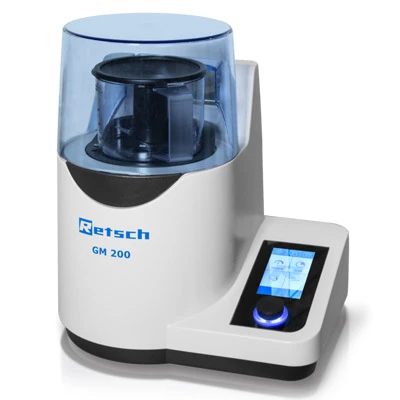
For the detection of GMO a smaller analysis sample, approx. 1000 g in case of corn or soy beans, is extracted from the laboratory sample and thoroughly homogenized. For PCR analysis only 2 mg of sample material are required. The homogenization step ensures that these 2 mg are representative of the whole sample. Whereas soft food and feed samples are easily homogenized, it can be a true challenge with hard and oily grains. This type of material calls for a suitable laboratory mill such as RETSCH’s GRINDOMIX GM 200.
Using RETSCH’s knife mill GRINDOMIX GM 200
The cutting effect generated by the sharp steel blades of the knife allows for very effective size reduction of samples with a high water, oil, sugar or fat content. The GM 200 covers a wide application range from grainy food stuff such as rape seed, rice, soy beans or corn to fibrous or tough samples such as meat, fish, sticky candy or cheese. The mill features three different operation modes (standard mode = cutting, reverse mode = impact, interval mode =
improved sample mixing) to optimize the homogenization process with regard to the material properties. Up to 3 programs can be stored for
routine applications. A wide selection of accessories allows for individual adaptation to application requirements. The grinding containers are available in steel, glass, polycarbonate, and polypropylene and accept up to 700 ml of sample material. A gravity lid is available to reduce the sample volume during the grinding process, thus permitting thorough homogenization of samples with high liquid content. It is equipped with overflow channels through which the liquid which flows up on the container walls (capillary effect), is returned to the center of the container, ensuring that no sample material is lost and the results are not falsified. The so-called reduction lid reduces the container volume to 0.5 l thus submitting smaller sample volumes up to 0.35 l continuously to the grinding process.
Product-specific size reduction
Grainy food and feed stuff such as soy beans is processed in a steel container at 10,000 rpm. With batches of 4 x 250 g grind sizes below 0.5 mm can be obtained within 30 seconds. The grinding tools are cleaned by scour-wipe-disinfection for the next application.
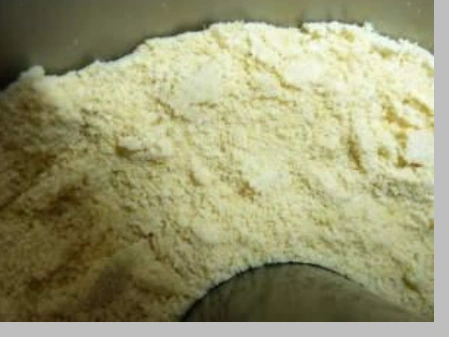
The GM 200 can easily process tough sample materials such as meat or fish. 250 g meat is placed into the polycarbonate container and homogenized at 4,000 rpm for 15 seconds in standard mode, and then a few seconds more in reverse mode to release the tougher meat pieces which stick to the knifes. Another 15 seconds in the standard mode complete the homogenization process.
Approximately 2 g of the homogeneous sample is now submitted to DNA extraction to recover the genetic material required for the actual GMO detection. Gen-IAL uses a variety of kits, depending on how difficult the matrices are. With a threshold value as low as 0.9% the detection sensitivity of the analysis method needs to be very high. Officially, 1 grain in 10,000 must be found which corresponds to a GMO detection limit of 0.01%. For native materials such as untreated plants (corn, soy beans, rape seed) it is easy to meet this value. However, if the samples only have little intact DNA, such as soy lecithin, the detection limit goes up to 0.1 to 1 %.
Avoid cross-contaminations
The entrainment of material of a GMO-positive sample into a negative sample can have extensive economic and legal consequences. Therefore, the spatial separation of sample preparation, DNA extraction and PCR analysis is a must. In addition, all tools which have come into contact with the sample material need to be thoroughly cleaned. Due to a typically high sample throughput in most laboratories, the cleaning process should be quick and efficient which is guaranteed with the GRINDOMIX GM 200. All parts of the mill which were in contact with the sample – container, knife, lid – can be conveniently cleaned by hand or in a dishwasher. Except for the PP container all the above mentioned parts are autoclavable.
Novel Food/Novel Feed-Verordnung (VO (EG) Nr. 1829/2003) und der Rückverfolgbarkeitsverordnung (VO (EG) Nr. 1830/2003)
How can a test portion retain the composition of a mixed feed?
Sample reduction should preserve the proportions of the original material while producing material suitable for extraction. Control carryover between samples and define the amount entering the assay. The preparation method and extraction controls should be assessed together rather than treating milling as an unrelated preliminary task.
| Consideration | Information to provide |
|---|---|
| Sample mixture | Grain or feed components |
| Carryover controls | Cleaning and sample sequence |
| Assay input | Portion size and extraction compatibility |
Discuss material testing with Glen Mills or Contact Glen Mills for information or a quote.