

Does visual cleanliness demonstrate absence of carryover?
No. Select a check that can detect the contamination relevant to the assay. The required cleaning evidence depends on the analytical objective.
The analysis of food for contaminants such as heavy metals, pesticides, or other toxic substances is a central component of quality control and consumer protection. Regulatory frameworks such as Regulation (EU) 2023/915 establish clear limits for undesirable substances in food. Modern analytical methods such as ICP-MS enable the reliable detection of even the lowest concentrations. Especially in routine analysis of food and feed, reproducible, contamination-free sample preparation is crucial for valid results.
But this is precisely where a frequently underestimated problem lies: The greatest source of error often lies not in the analysis itself, but one step before it – in sample preparation. For measurement results to be valid, a sample must meet two fundamental requirements: It must be homogeneous and representative. Mechanical milling is necessary to ensure these preconditions. At the same time, the properties to be analyzed must not be altered in the process, for example, by contamination. Tool wear during the milling process is inevitable, however, and can unintentionally introduce metals into the sample. These metals can influence the analysis result. In extreme cases, this means: Not only is the sample analyzed - but also the tool used.
Why is abrasion a problem?
During grinding, metallic particles from tools can be introduced into the sample. In food and feed analysis, this is particularly critical, as elements such as lead, cadmium, nickel, or chromium are toxicologically relevant and subject to strictly regulated limits. Even small additional contaminants can lead to samples being incorrectly classified as exceeding limits or to trends in monitoring programs appearing distorted. For laboratories, this poses a significant risk – ranging from unnecessary re-analyses to incorrect evaluations. Even small additional inputs during sample preparation can therefore have significant consequences. Sample preparation is thus not a neutral step, but a potentially decisive factor influencing the analytical result.
Purpose of the study
This study aimed to systematically investigate how different tool materials influence heavy metal contamination during the milling process. For this purpose, the cutting mill SM 50 was used in two configurations: a stainless steel version and a low-heavy-metal variant based on an aluminum / steel combination. A key feature of the SM 50 is the simple and flexible interchangeability of the grinding tools. This allows the system to be specifically adapted to different samples and analytical requirements. The focus is on a clear approach: abrasion must not only accepted, but actively controlled.
Materials and methods
Elemental concentrations were determined using inductively coupled plasma mass spectrometry (ICP-MS), a well-established method for the quantitative analysis of trace elements in food samples with high sensitivity and accuracy. Two different samples were selected as test materials to represent both typical and extreme conditions. Buckwheat served as a low-abrasion, representative food sample. Oats with husks were used as a highly abrasive worst-case scenario. The study examined the influence of the tool material and the grinding intensity on sample contamination. Different grinding tools were used, along with coarse 2 mm and fine 0.75 mm sieves. Grinding was performed at 4,000 rpm.
A homogenized sample, which was prepared without any material-related contamination, was used as a reference. This ensures that only the sample’s original element concentrations are recorded and used as the basis for determining the contamination introduced by the mill.
Factors that influence abrasion intensity
The SM 50 with a stainless steel grinding chamber was used to assess the abrasion intensity. Since iron is the main component of stainless steel, its content in the material serves as an indicator of abrasion intensity. The results show a significant increase in iron content relative to the reference:
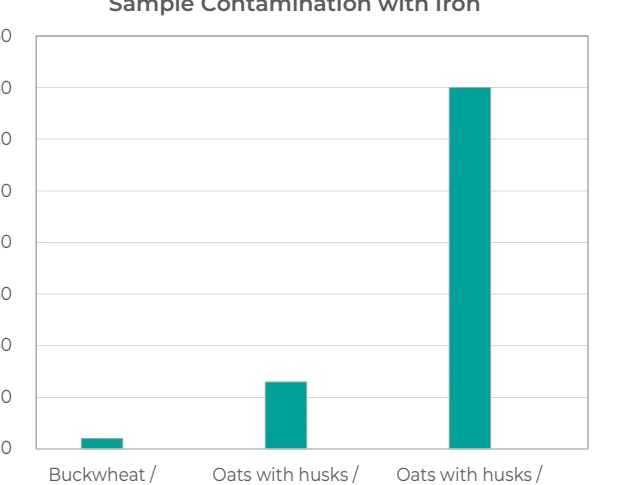
Sample Contamination with Iron
g k / g m n i l
Buckwheat / 0.75 mm sieve
Oats with husks / 2 mm sieve
Oats with husks / 0.75 mm sieve
There is a clear correlation between the sample matrix, process parameters, and abrasion intensity. As the abrasiveness of the sample increases, abrasion of the grinding tools rises significantly. At the same time, more intensive grinding - for example, using finer sieves - further amplifies this effect. Particularly striking is the sharp increase observed when oats are combined with a fine sieve. This can be attributed to increased mechanical stress as well as longer residence times in the grinding chamber. The results clearly demonstrate that abrasion is not a constant effect. It is largely determined by the properties of the sample and the selected process parameters.
Heavy metal contamination analyses - using buckwheat as an example
Buckwheat is a typical sample encountered in everyday laboratory work, and grinding it is sometimes challenging due to its material properties. Depending on the mill, this can result in insufficient fineness, low throughput, or increased cleaning effort. The SM 50 is well-suited for this purpose. The measurement results show the extent of contamination caused by the SM 50 and that it occurs even under mild conditions; see Table 1.
| Element [mg/kg] | Reference | SM 50 / low-heavy-metal variant | SM 50 / stainless steel | Assessment stated in the comparison |
|---|---|---|---|---|
| Chromium (CR) [mg/kg] | 0.21 | 0.49 | 0.80 | no defined legal maximum |
| Nickel (NiR) [mg/kg] | 0.15 | 0.26 | 0.38 | 0.5 mg/kg (cereals, in accordance with regulation (EU) 2023/915) |
How should a laboratory define contamination for a food assay?
Define the contamination risk against the assay, whether it concerns allergens, residues or analytical elements. Make the cleaning method observable and repeatable, and consider difficult-to-access parts of the vessel and discharge path. A clean appearance is useful but is not the same as an analytical carryover check.
| Consideration | Information to provide |
|---|---|
| Relevant contamination | What the test must distinguish |
| Cleaning sequence | Surfaces and retained residues |
| Verification | Blanks or appropriate carryover controls |
Discuss material testing with Glen Mills or Contact Glen Mills for information or a quote.