
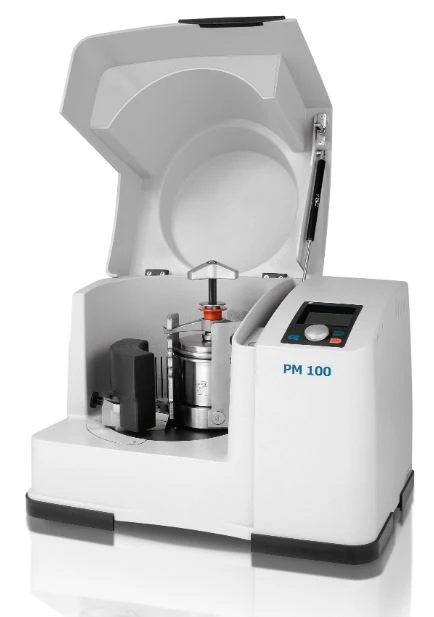
Is there a grinding tool that avoids every contamination risk?
No single material suits all analyses. Match tool composition and wear behavior to the sample and the elements or properties being investigated.
Reliable and accurate analysis results can only be guaranteed by reproduc-
ible sample preparation. This consists of transforming a laboratory sample
into a representative part sample with homogeneous analytical fineness.
Choosing the correct grinding tool and accessories will help to ensure con-
tamination-free preparation of a great variety of sample materials.
The selection of the correct grinding tool depends on the sample material and the subsequent method of analysis. Different grinding tools have different characteristics, such as required energy input, hardness or wear-resistance. For instance, tungsten carbide, being the densest material, imparts the most energy into the sample and is suitable for breaking down hard material in the shortest time. On the other
hand, Teflon has a low density and is suitable for grinding samples that easily disintegrate, such as dry leaves. The potential for contamination, density, hardness and wear resistance all must be considered when selecting the grinding tools. Even when using the most appropriate grinding tools, care must be taken to ensure that the correct amount of sample is placed in the grinding container as too little sample will
result in damage to the grinding tools in a mixer mill or a planetary ball mill. This is especially crucial for high-energy grinding over long periods. Too much sample in the grinding container reduces the efficiency of the grinding process. In order to successfully carry out size reduction in a planetary ball mill, it is recommended that the jar filling should consist of about 1/3 sample and 1/3 ball charge. The remaining third is the free jar volume that is necessary for the free movement of the grinding balls, although this can be different in the case of colloidal grinding. Hence, selecting the correct tools for any application requires consideration of the sample properties, including hardness, starting size, required final fineness, time of comminution, etc. Some samples require the addition of liquids to avoid agglomeration. Alternatively, solids such as talcum or aluminium oxide can be used to prevent agglomeration in some instances. Other
Material composition of Retsch grinding tools
Tungsten Carbide
Zirconium Oxide
Stainless Steel
Heavy Metal - Free Steel
Stainless Steel - Wear Resistant Coating
Composition*
Composition*
Composition*
Composition*
Composition*
WC Co
ZrO2 94,500 % Y2O3 05,200 % SiO2 < 00,300 % MgO < 00,300 % CaO < 00,300 % Fe2O3 < 00,300 % Na2O < 00,300 %
C Si P S Mn Cr Ni Fe
C Si Mn P S Fe
C Si Mn P S Cr Ni Mo Fe
* Composition of the material varies depending upon the specific tool, e.g., breaking jaws, grinding jar or rotor.
Contamination resulting from grinding limestone
| Instrument / configuration | Grinding tool | Detected contamination |
|---|---|---|
| BB 50 | Zirconium oxide | Zr <1 ppm |
| BB 50 | Tungsten carbide | W: 5 ppm; Co: 3 ppm |
| BB 100 | Manganese steel | Cr: 6 ppm; Ni: 3 ppm; Fe: 300 ppm (estimate) |
| PM 100 | Stainless steel | Cr <1 ppm; Ni <1 ppm |
| PM 100 | Zirconium oxide | Zr <1 ppm |
| PM 100 | Tungsten carbide | W: 5 ppm; Co <1 ppm |
| PM 100 CM / centrifugal mode | Stainless steel | Cr <1 ppm; Ni <1 ppm |
| PM 100 CM / centrifugal mode | Zirconium oxide | Zr <1 ppm |
| PM 100 CM / centrifugal mode | Tungsten carbide | W <1 ppm; Co <1 ppm |
| MM 400 | Stainless steel / 50 mL jar | Cr: 26 ppm; Ni <1 ppm; Fe: 0.15% (estimate) |
| MM 400 | Zirconium oxide / 35 mL jar | Zr: 35 ppm |
| RS 200 | Hardened steel / 250 mL jar | Cr: 1 ppm; Ni <1 ppm |
| RS 200 | Tungsten carbide / 250 mL jar | W: 8 ppm; Co: 1 ppm |
| RS 200 | Zirconium oxide / 100 mL jar | Zr: 1 ppm |
a (gap width = 0); b (5 minutes using a 500 ml jar at 400 min-1, 200 g sample with 8 x 30 mm grinding balls); c (1 minute at 30 Hz); d (2 minutes at 1,400 min-1)
samples which are difficult to grind because they are highly elastic can be embrittled by lowering the temperature with liquid nitrogen or dry ice before or during the grinding process. Cooling is also necessary if the sample contains volatile compounds of interest. The method of analysis following the grinding process also influences the selection of the grinding tools. Retsch provides information on the material composition of the grinding tools which can assist in choosing the most appropriate material in order to minimize any contamination from abrasion of the grinding tools. Table 1 provides selected examples of the material of composition used to manufacture the company’s grinding tools. However, not every grinding tool material is available for every device. Depending upon the nature of the sample, the grinding set available and the required final fineness, there is a chance that there will be some contamination from abrasion of the grinding tool material in the
sample when using laboratory mills. So if grinding sets are subject to wear, how significant is the contamination from abrasion of the tools? In this article, we investigate the amount of contamination resulting from the grinding tools for different sample types.
Experimental
Two different samples were studied, limestone and maize (corn) in order to investigate possible contamination from metals present in the grinding tools.
Limestone and Maize
Limestone was ground using four different grinding/impact mill types (Jaw Crusher – BB 50 and BB 100, Planetary Ball Mill – PM 100 and PM 100 CM, Mixer Mill – MM 400 and Vibratory Disc Mill – RS 200) with a variety of grinding
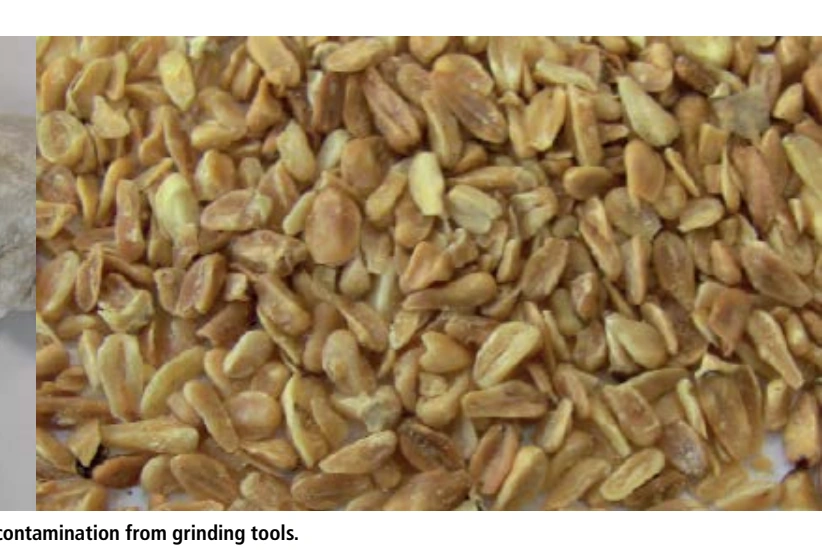
Contamination resulting from milling maize
a (parallel section rotor with 4.0 mm sieve); b (12 tooth rotor with 2.0 mm sieve) c (Stainless steel knife at 10,000 min-1); d (Stainless steel knife at 4,000 min-1)
tool materials. Similarly, maize was tested using three different cutting/shearing mill types (Cutting Mill – SM 300, Ultra Centrifugal Mill – ZM 200, and Grindomix – GM 200 and GM 300) again with a variety of cutting tool materials. The elements Co, Cr, Ni, W, Zr were tested in limestone by ICP-OES after acid digestion of the ground sample. Iron was also measured, however as Fe is present at high (%) levels in limestone, any Fe contamination from abrasion of the tools is only an estimate. The elements Cr, Fe, Mn, Ni, Ti were tested in maize again using ICP- OES after acid digestion of the ground sample. A sample blank for the elements of interest was obtained for the limestone after grinding with a contamination neutral material, in this case using a zirconium oxide (ZrO2) jar and grinding balls with a PM 100. The limestone was also ground in a PM 100 using a tungsten carbide (WC) jar and grinding balls in order to get a blank value for zirconium. A sample blank was obtained for the maize after grinding with a ZM 200 using a titanium rotor and a TiNb coated sample cassette. The blank values were subtracted from elemental analyses of limestone and maize samples that were subsequently ground with tools made of different materials. This way any contamination
from the grinding tools could be determined. The blank measurement step can be avoided if reference materials with a known elemental composition are available; however these are usually expensive and are not available for all sample types.
Results Limestone
The results obtained for the amount of contamination due from abrasion of the grinding tools for different instruments when milling limestone are shown in Table 2. For the majority of the results in table 2, no significant contamination from the grinding tools can be detected. A very low concentration of tungsten and cobalt can be found when using tungsten carbide tools with jaw crushers, the disc mill and the PM 100 planetary ball mill. Interestingly, significantly less tungsten or cobalt contamination is seen when using the PM 100 CM planetary ball mill, as this mill has a lower grinding jar rotation speed (0.5x) compared to the PM 100, which leads to a more gentle size reduction process with less abrasion. Some chromium, nickel, and (especially) iron contamination is observed when using steel-based grinding tools as expected, hence these tools
should be avoided if possible when trace metal analysis is required. Overall, the level of contamination from abrasion of the grinding tools is so low, even when using steel-based hardware, that it is unlikely to be significant for most analytical applications. For instance, the levels of contamination of nickel and chromium seen from stainless steel tools is well below the maximum levels of metal contamination allowable in reclaimed soil according to German Standard BBodSchV Annex 2.
| Instrument / condition | Contact material | Detected contamination |
|---|---|---|
| SM 300 / 700 rpm | Low-heavy-metal steel and stainless steel parts | Cr, Mn, Ni, Ti <1 ppm; Fe: 5 ppm |
| SM 300 / 1,500 rpm | Low-heavy-metal steel and stainless steel parts | Cr, Fe, Mn, Ni, Ti all <1 ppm |
| SM 300 / 3,000 rpm | Low-heavy-metal steel and stainless steel parts | Cr, Fe, Mn, Ni, Ti all <1 ppm |
| ZM 200 | Stainless steel | Cr, Fe, Mn, Ni, Ti all <1 ppm |
| GM 200 | Polypropylene container | Cr, Mn, Ni, Ti <1 ppm; Fe: 1 ppm |
| GM 200 | Stainless steel container | Cr, Mn, Ni, Ti <1 ppm; Fe: 1 ppm |
| GM 300 | Polycarbonate container | Cr, Mn, Ni, Ti <1 ppm; Fe: 2 ppm |
| GM 300 | Stainless steel container | Cr, Mn, Ni, Ti <1 ppm; Fe: 2 ppm |
Results Maize
Maize, while brittle, is obviously not as hard as limestone, hence cutting and centrifugal mills are suitable for this sample type. The results obtained for the amount of contamination due from abrasion of the grinding tools for different instruments when milling maize are shown in the Table 3 on the previous page. Very little evidence of metal contamination from the grinding tools can be detected when milling maize. Iron can be detected at 5 ppm in the sample when using the SM 300 Cutting Mill operated at 700 rpm, as the maize spends more time in the grinding chamber in order to pass through the 4.0 mm sieve at the lowest speed. Iron in the range of 1-2 ppm can be detected in the sample when using the Grindomix GM 200 and GM 300. The amount is not related to the material of construction of the sample container suggesting that any contamination is coming from the cutting knife itself. This contamination could be eliminated by using a TiNb coated cutting knife if the analysis of iron was important.
Conclusions
Size reduction is an essential part of the preparation process for solid samples. A wide range of mills and crushers for coarse, fine and ultra-fine size reduction of almost any material are now available. Depending upon the nature of the sample, the grinding tools available and the required final fineness, the possibility always exists for some contamination from abrasion of the grinding tools when using laboratory mills. In the end however, while some contamination was evident with certain combinations of milling techniques and grinding or cutting tools, the amount was generally so low that it would not influence the outcome of any analytical result. Furthermore, almost all the contamination could be eliminated through correct selection of the materials used for the grinding and cutting tools.
How should tool wear be evaluated for a trace-metal assay?
Consider contamination relative to the analytical question, not whether a tool is described as clean in general. A material appropriate for one assay may introduce an element relevant to another. Preparation blanks and suitable comparisons help evaluate whether the grinding arrangement changes the result.
| Consideration | Information to provide |
|---|---|
| Analytes | Elements that must not be introduced |
| Tool choice | Material and expected wear |
| Verification | Blanks and comparison preparations |
Discuss material testing with Glen Mills or Contact Glen Mills for information or a quote.
Explore the equipment discussed
- RETSCH PM 100 Planetary Ball Mill
- RETSCH SM 300 Cutting Mill
- RETSCH RS 200 Vibratory Disc Mill
- RETSCH GM 200 Knife Mill