Standard
A starting point for general iron removal.
5, 7, 10, 12, 15 and 20 mm intervals.

ELECTROMAGNETIC SEPARATION EQUIPMENT
High-intensity magnetic separation removes fine ferrous contamination from powders using an energized screen matrix and vibration-assisted flow.
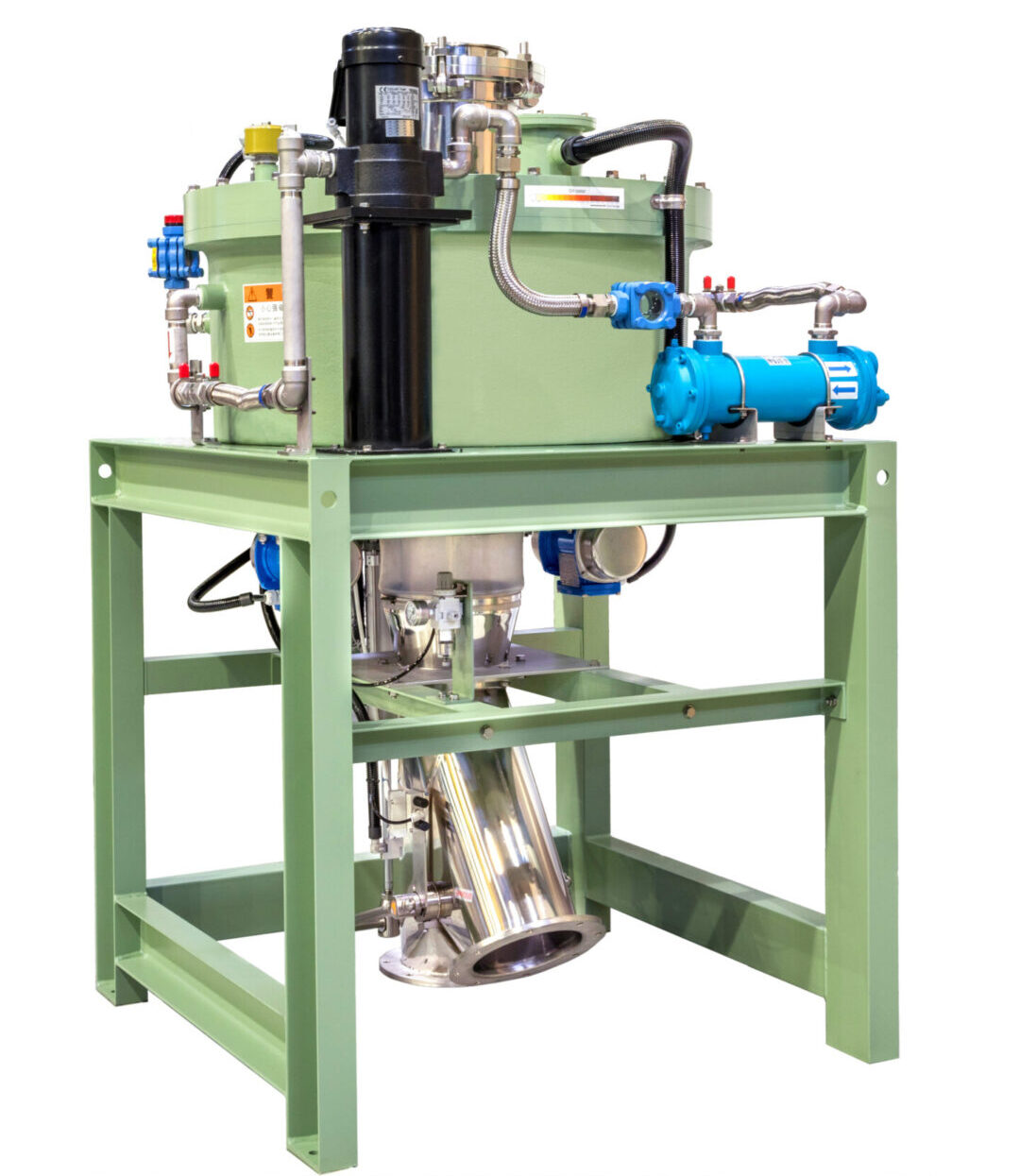
SEPARATE BY MAGNETIC RESPONSE
Powder travels through a stack of magnetized screens. The concentrated field attracts fine iron particles to the matrix; vibration helps material pass through the assembly.
Establish a controlled flow through the separation zone.
Energized screens retain magnetically responsive contamination, including particles below 10 microns in suitable applications.
Automatic contaminant discharge and removable screen assemblies support cleaning and product changeover.
INTERCHANGEABLE CAPTURE MATRICES
Balance magnetic contact area, powder flow and contaminant loading. These capture screens serve a different purpose from a test sieve used to measure particle size.

A starting point for general iron removal.
5, 7, 10, 12, 15 and 20 mm intervals.
Fine capture geometry for anode materials and demanding battery applications.
Evaluate capture efficiency alongside powder flow.
More magnetic surface area for difficult contamination.
Match the matrix and stack to the material.
An option for powders with a lower contamination load.
Review loading and cleaning frequency.
CONFIGURATION GUIDE
Available configurations reach up to 19,500 Gauss on the screen. Screen geometry, feed behavior and operating conditions determine separation performance.
| Configuration* | Magnet power | Screen flux density | Screen count |
|---|---|---|---|
| Standard 150 | 6.11 kW | 15,500 Gauss | 20 |
| Standard 250 | 8.1 kW | 16,000 Gauss | 17 |
| Standard 300 | 9.53 kW | 15,500 Gauss | 17 |
| High-intensity 150 | 13.4 kW | 18,500 Gauss | 20 |
| High-intensity 250 | 17.5 kW | 19,500 Gauss | 17 |
| High-intensity 300 | 19.7 kW | 18,500 Gauss | 17 |
*Descriptive configuration labels. Confirm the selected unit, electrical supply, installation dimensions and utilities with Glen Mills. Magnet power is not a throughput rating.
Dry-powder applications are the main focus. Wet-processing arrangements require review of the material and selected configuration.
Class II, Division 2 and UL-rated options can be reviewed for the installation. Confirm the required rating for the specific quoted system.
Agree on the incoming contamination, required residual level and analytical method. Field strength alone does not establish the final purity or processing rate.
MATERIALS & APPLICATIONS
Start with the valuable material, the contamination to remove and the quality requirement. A representative trial helps establish the right screen and operating conditions.
Anode and cathode powders, including graphite and other contamination-sensitive materials.
Assess magnetic contamination in relation to the intended powder composition.
Review iron contamination in raw materials and fine powders.
Evaluate fine iron removal from carbon black, pigments and other specialty materials.
BEFORE YOU SELECT
No. Sieving separates particles by size. Electromagnetic separation captures contamination according to magnetic response. The two processes may be used together.
Capture depends on the magnetic response of the contaminant. Share its composition and size so the team can assess suitability with your product.
Powder flow, bulk density, screen geometry, contamination loading and the required removal efficiency all matter. Establish a useful processing rate through application review and testing.
Discuss a representative material trial with Glen Mills. Agree on the sample quantity, safety information, screen configuration and acceptance criteria before shipping.
TALK WITH GLEN MILLS
Tell us what you process, what needs to be removed and the working scale. We’ll help review the magnetic separation approach and quotation.