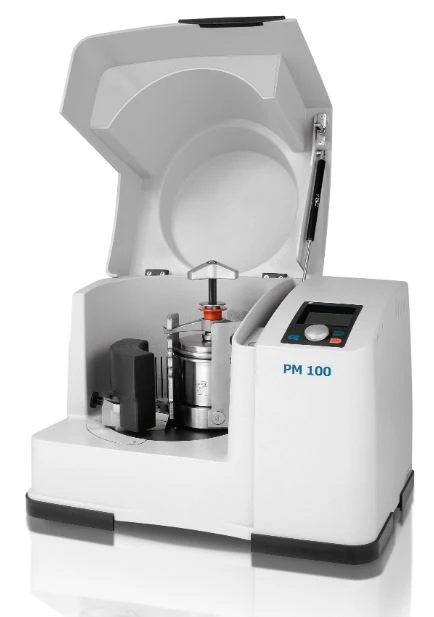
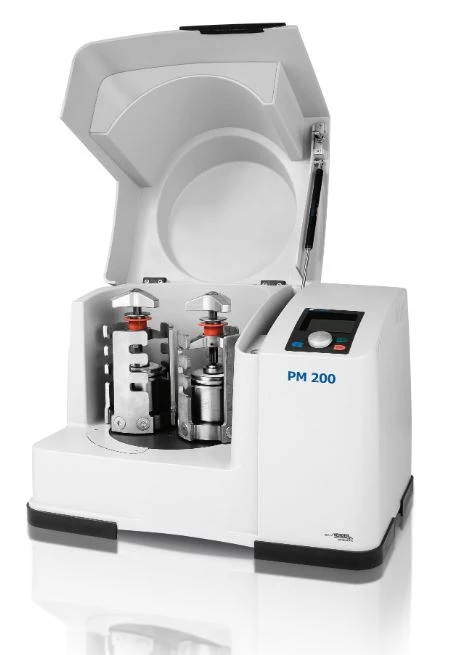
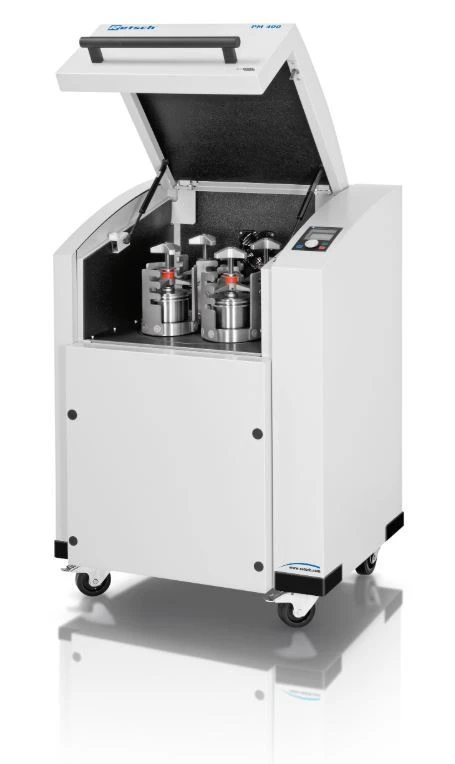
More energy for demanding methods
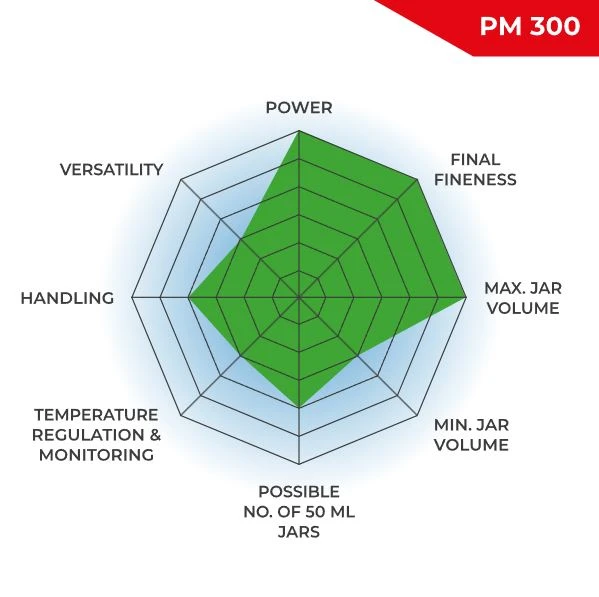
A large 180 mm sun wheel and speeds up to 800 rpm provide an acceleration rating of approximately 64 g. Match energy input to fineness, chemistry and temperature response.

POWERFUL. ERGONOMIC. ADAPTABLE.
Combine two freely accessible grinding stations with a large sun wheel and speeds up to 800 rpm. The PM 300 supports demanding dry and wet grinding, mechanical alloying and mechanochemical synthesis with jars up to 500 ml.
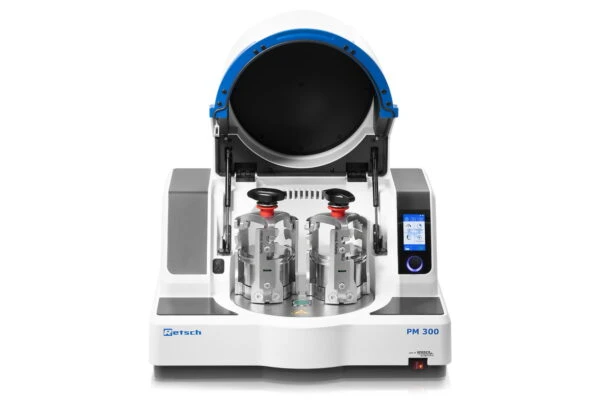
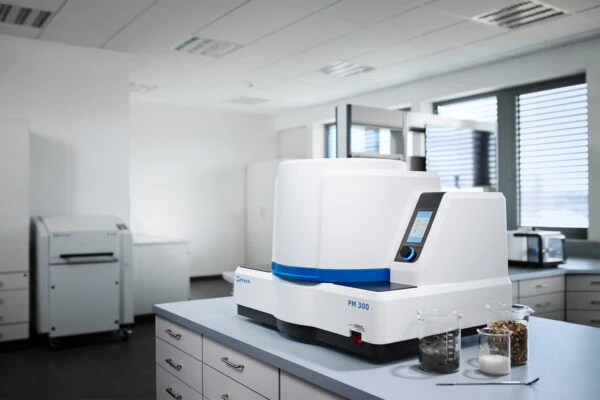
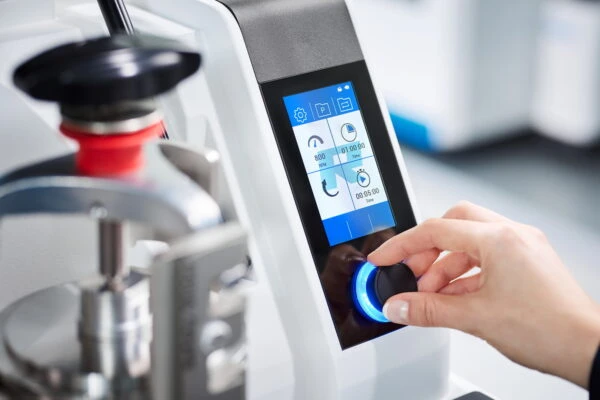
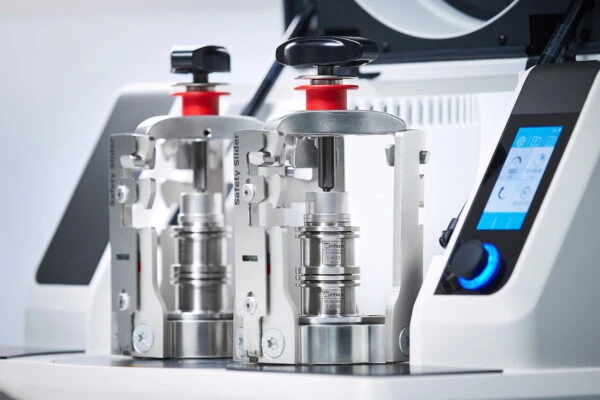
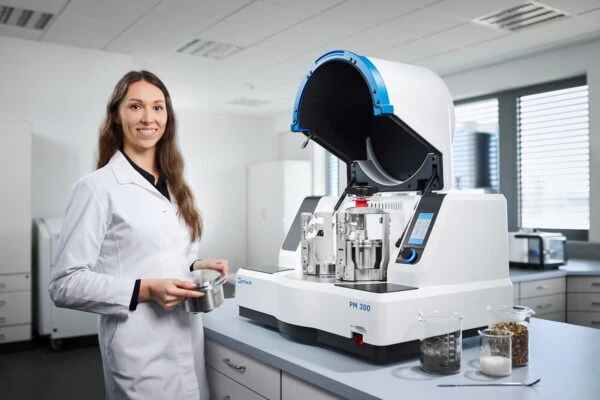
Configuration examples. Jars, lids, adapters and monitoring accessories may be optional.
THE MODEL IN FOCUS
A large 180 mm sun wheel and speeds up to 800 rpm provide an acceleration rating of approximately 64 g. Match energy input to fineness, chemistry and temperature response.
Use two jars up to 500 ml nominal volume for useful sample quantities up to 2 × 220 ml, or stack compatible smaller jars for small-scale investigations.
A touch display, open access to both stations, a lockable sun wheel and stored methods support routine use and research development.
HOW PLANETARY BALL MILLS WORK
Grinding jars sit eccentrically on a rotating support disc, or sun wheel. Each jar turns around its own axis in the opposite direction. The combined motion accelerates the balls and creates repeated ball-to-ball and ball-to-wall interactions.
Impact and friction reduce particles, mix components and can supply mechanical energy for solid-state reactions. The balance changes with speed, ball size, loading, jar geometry and whether the method is dry or wet.
The PM 300 sun-wheel range is 50–800 rpm. Its sun-wheel-to-jar speed ratio is 1:−2.
Feed limits, useful sample quantity and achievable fineness depend on the material, jar, ball charge and operating conditions. Nominal jar volume is not the sample filling volume. Sub-100 nm results require a suitable wet-grinding method; maximum batch size and finest result are not simultaneous guarantees.
HANDLING & REPRODUCIBILITY
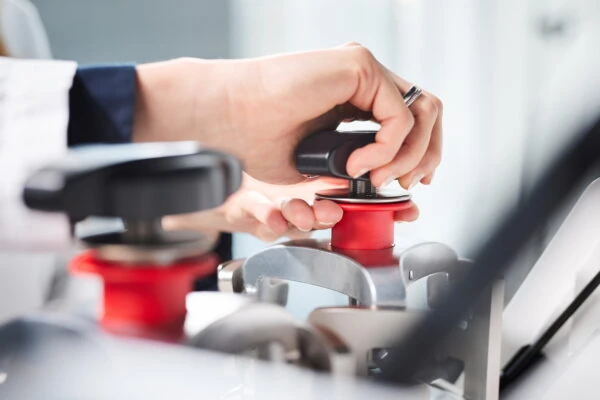
The lockable sun wheel helps position the jars for loading. The PM 300 provides an acoustic signal and display notification when the specified clamping force of 25 Nm is reached; an optional clamping aid can assist handling.
WET & NANO-SCALE GRINDING
Dry grinding can reach analytical fineness below 1 µm for suitable samples. Wet colloidal methods can extend below 0.1 µm when the material, ball charge and dispersion support it.
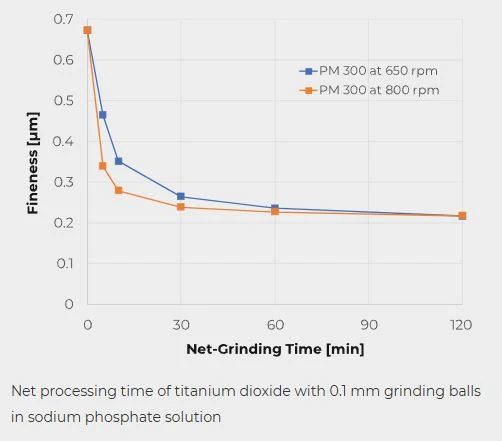
The titanium dioxide example compares 650 and 800 rpm with 0.1 mm grinding balls in sodium-phosphate solution. Higher speed reduces the particle size faster early in the process, but the additional warming may require longer cooling breaks. Compare total elapsed time and sample temperature alongside net grinding time.
Small particles can agglomerate as their surface interactions become more important. A suitable liquid or dispersant helps keep particles separated, while many small balls increase frictional contacts.
Review process temperature and cooling pauses alongside the size distribution. The example result is specific to its material and method.
MECHANOCHEMISTRY & SOLID-STATE RESEARCH
Planetary milling supplies impact and friction for research that goes beyond particle-size reduction. Choose the energy input, jar and atmosphere around the chemistry.
The PM 300 retains a 1:−2 speed ratio while combining a large sun wheel with up to 800 rpm. Its approximately 64 g acceleration rating and choice of two large jars or four stacked small jars support mechanochemical method development.
Explore solid-state synthesis, catalyst or composite preparation, and reactions with reduced bulk solvent during the milling stage. Pharmaceutical research applications include investigating active pharmaceutical ingredient synthesis and solid-form development. The appropriate method depends on the chemistry; evaluate the reaction product and the full process rather than inferring success from a milling program alone.
Compare impact-driven MM 400 research methodsSmall-vial adapters allow parallel screening with limited research quantities. The outer ring of a compatible adapter accepts up to 16 vials. The actual sample count depends on the compatible adapter, ring position, station count and loading configuration.
The eight inner-ring positions provide a different energy input for comparative research. Keep vessel format, ball charge, liquid addition and position in the method record, and confirm solid-phase formation analytically.
Explore a co-crystallization application exampleJARS, BALLS & PROCESS OPTIONS
The jar, ball charge and closure determine what the sample experiences. Confirm each accessory against the model, jar size and application.
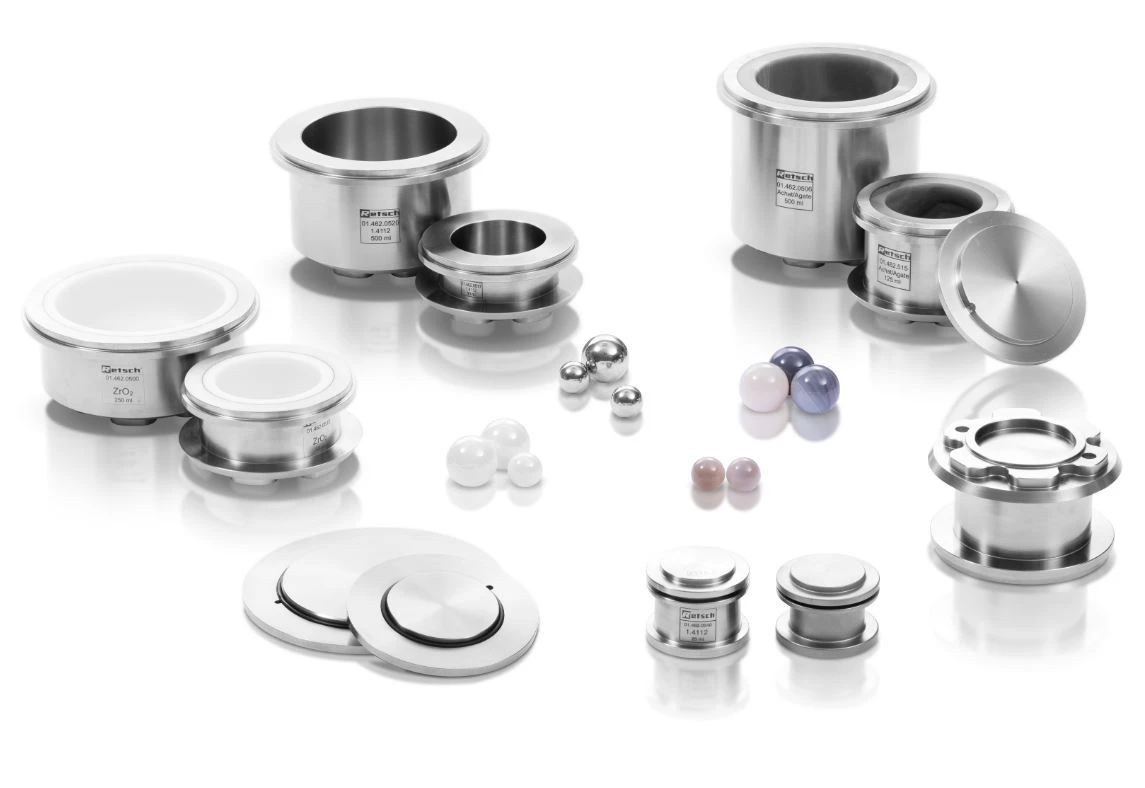
The PM 300 accepts 12, 25, 50, 80, 125, 250 and 500 ml nominal jar sizes. Advanced Anti-Twist geometry on applicable 50–500 ml jars helps resist twisting and simplifies positioning.
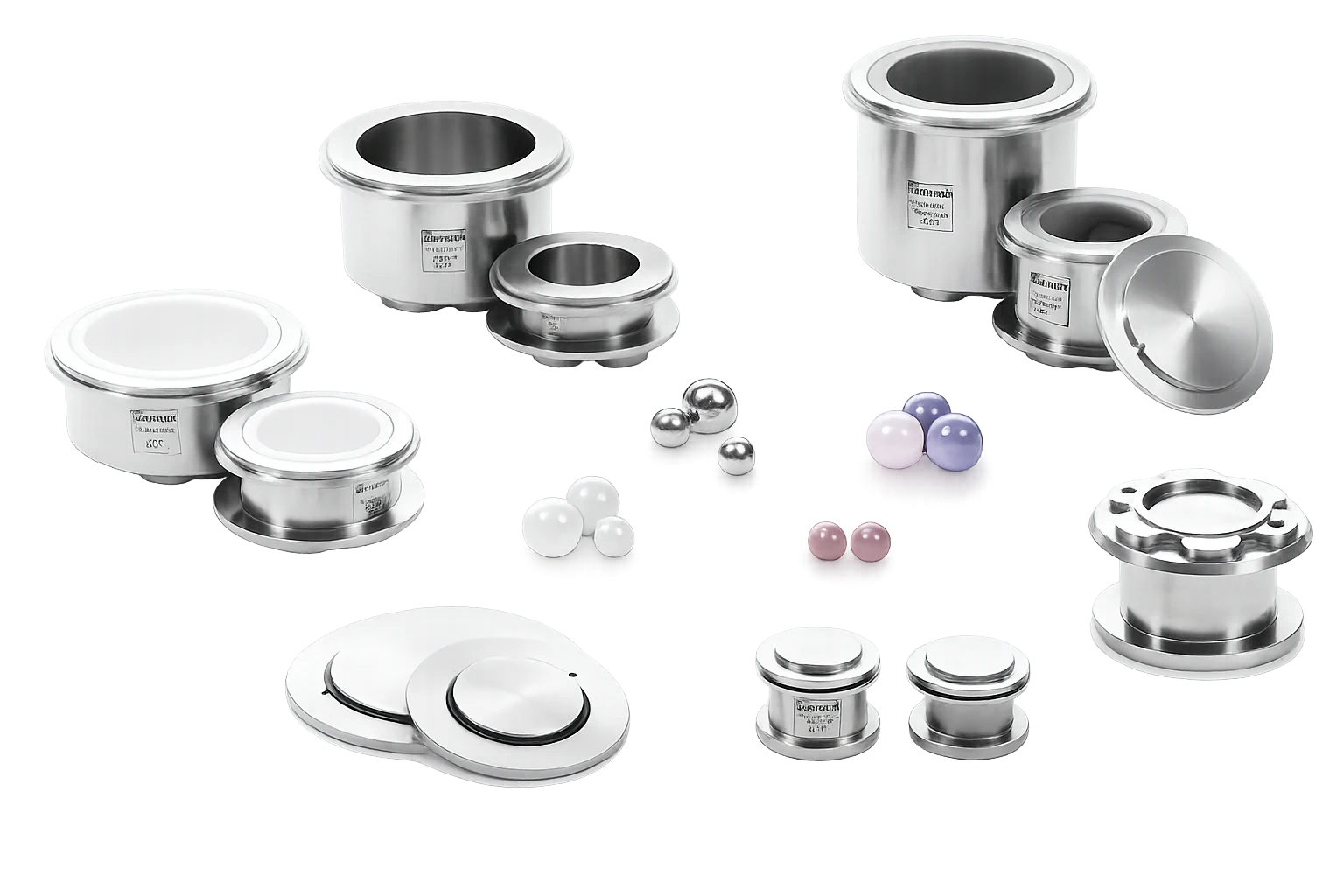
Options include hardened stainless steel, tungsten carbide, agate, sintered aluminum oxide and zirconium oxide. Additional steel or silicon-nitride formats depend on model and availability. Select for sample hardness, chemistry and acceptable wear contribution.
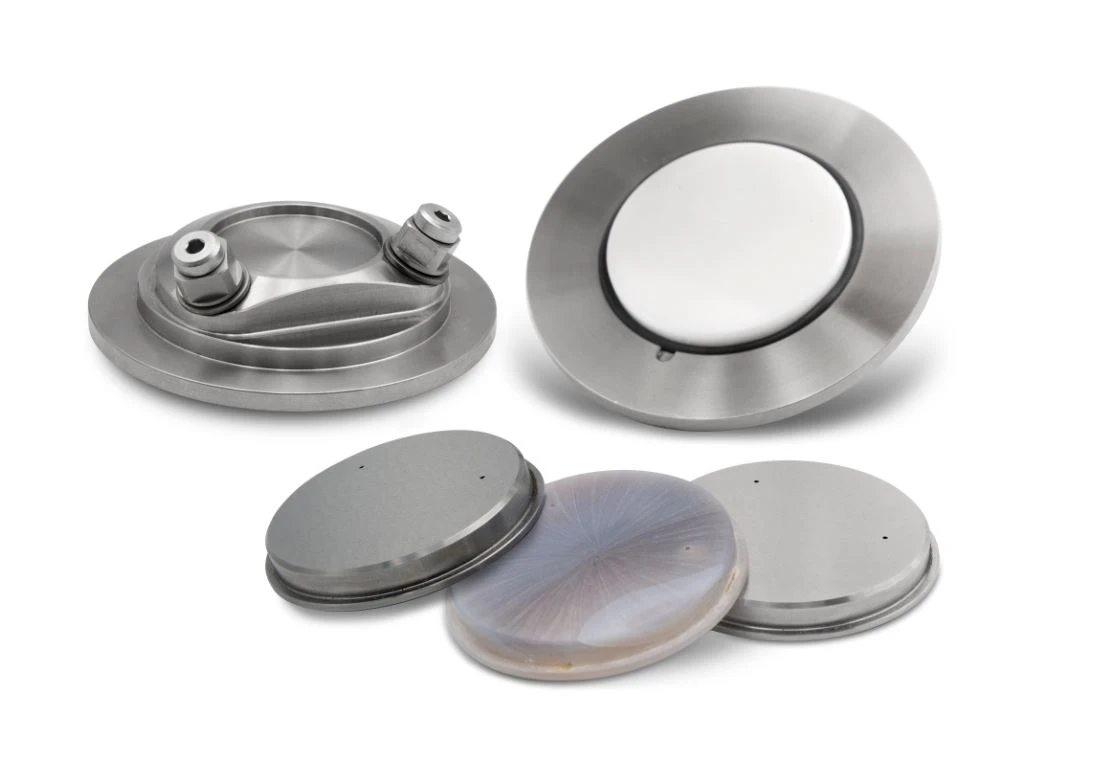
O-ring seals support pressure-tight, dust-resistant jar closure. Protective jackets are used on selected brittle-material jars. Compatible special closure devices are recommended for wet or colloidal grinding.
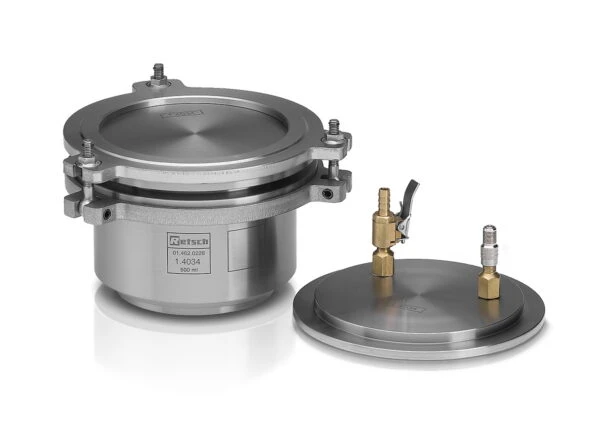
Compatible aeration lids allow a specified gas atmosphere inside the jar, such as nitrogen or argon. Interchangeable material inlays can match the contact surface to suitable jar materials.
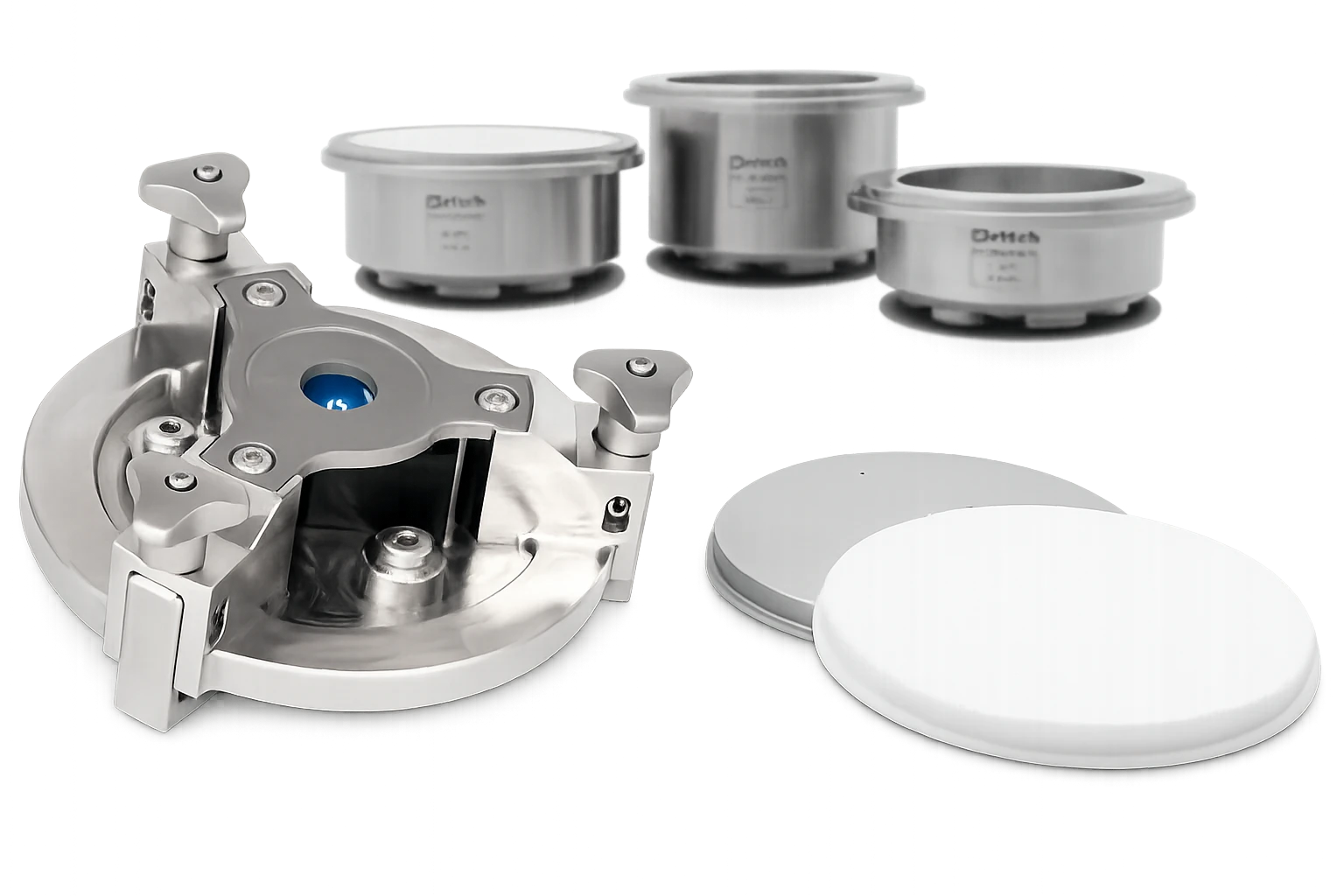
The optional measurement system records temperature and pressure inside a compatible jar. Use these data to study warming, gas evolution and reaction behavior. Monitoring does not actively cool the sample.
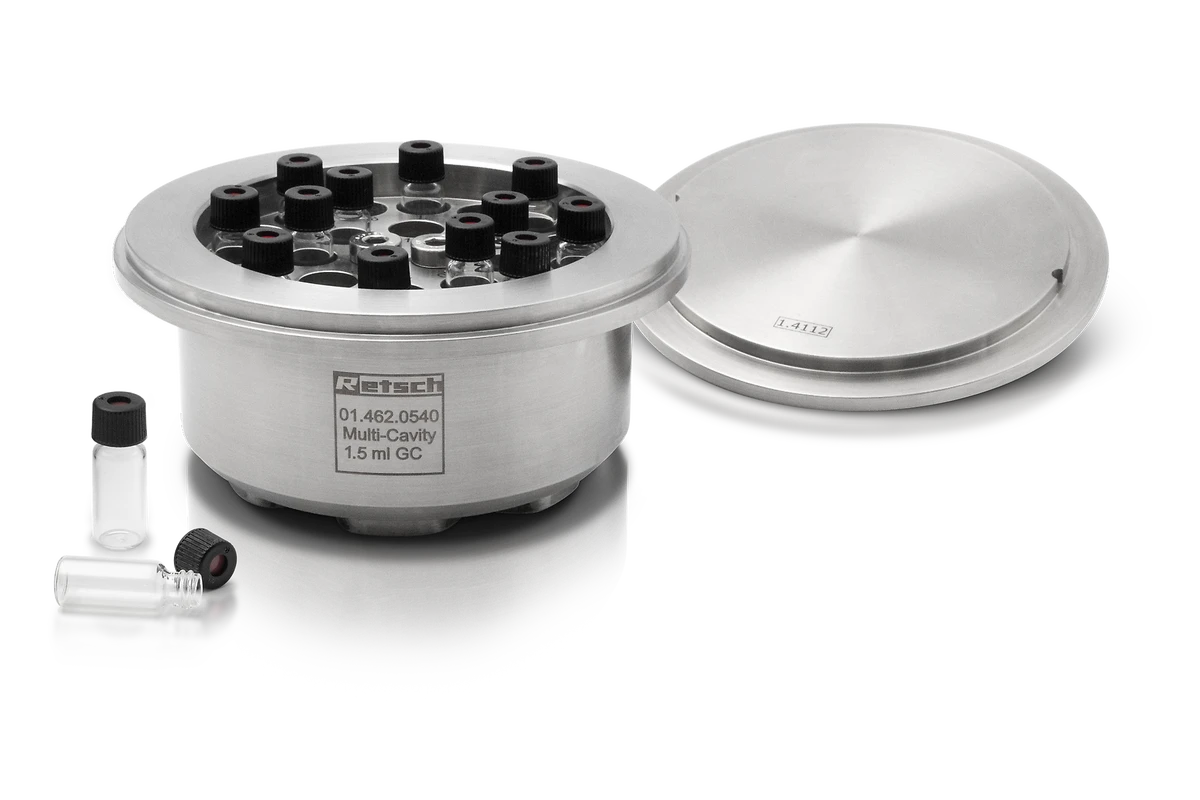
A compatible adapter offers an outer ring with 16 positions and an inner ring with eight positions for different energy conditions. Disposable 1.5 ml GC vials support small-sample screening; compatible 20 ml formats are also listed in selected models’ technical data.
PM 300: nominal jars 12–500 ml; useful sample quantity up to 2 × 220 ml. Compatible stacking: 12, 25, 50 and 80 ml jars; two compatible jars per station.
LOAD THE JAR WITH PURPOSE
Jar size and ball charge should be selected together. Dry impact grinding and wet ultrafine grinding use different filling strategies.
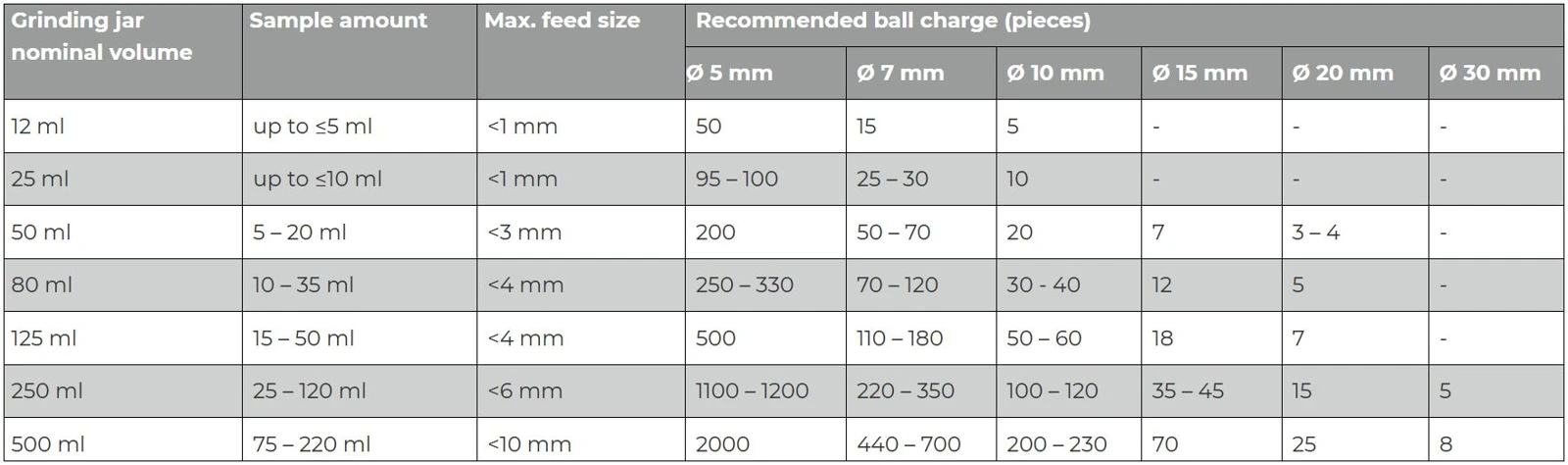
For conventional dry preparation, a useful starting rule is that grinding balls should be at least three times the largest feed dimension. The jar-filling chart relates nominal jar volume, sample amount, feed size and ball count.
One dry-grinding example uses a 500 ml jar for 200 ml of sample with pieces up to 7 mm, and 25 balls of at least 20 mm diameter. This is a starting example to evaluate, not a fixed charge for every material.
Wet ultrafine methods commonly use many smaller balls to increase frictional contacts. A wet-grinding starting point is approximately 60% jar filling with small balls; liquid volume, viscosity, dispersion and sample loading must be matched to the method.
Open the jar-filling chartMATERIALS & APPLICATIONS
TECHNICAL DATA
| Maximum feed size* | < 10 mm |
|---|---|
| Standard final fineness* | < 1 µm |
| Wet colloidal fineness* | < 0.1 µm with a suitable method |
| Grinding stations | 2 |
| Useful sample quantity* | 2 × 220 ml |
| Nominal jar volume | 12–500 ml |
| Sun-wheel speed | 50–800 rpm |
| Speed ratio | 1 : −2 |
| Acceleration rating | 64 g |
| Method storage | 12 SOPs and 4 cycle programs |
| Applications | pulverizing, mixing, homogenizing, colloidal milling, mechanical alloying, mechanochemistry, co-crystal screening |
|---|---|
| Feed material | soft, hard, brittle, fibrous – dry or wet |
| Size reduction principle | impact, friction |
| Material feed size* | < 10 mm |
| Final fineness* | < 1 µm, for colloidal grinding < 0.1 µm |
| Batch size / feed quantity* | max. 2 x 220 ml |
| No. of grinding stations | 2 |
| Speed ratio | 1 : -2 |
| Sun wheel speed | 50 – 800 min-1 |
| Effective sun wheel diameter | 180 mm |
| G-force | 64 g |
| Type of grinding jars | optional aeration covers, safety closure devices |
| Material of grinding tools | hardened stainless steel, tungsten carbide, agate, sintered aluminum oxide, zirconium oxide |
| Grinding jar sizes | 12 ml / 25 ml / 50 ml / 80 ml / 125 ml / 250 ml / 500 ml |
| Stackable grinding jars | 12 ml / 25 ml / 50 ml / 80 ml |
| Adapter for single-use glass vials | 24 x 1.5 ml / 7 x 20 ml |
| Setting of grinding time | digital, 00:00:01 to 99:59:59 |
| Interval operation | yes, with direction reversal |
| Interval time | 00:00:01 to 99:59:59 |
| Pause time | 00:00:01 to 99:59:59 |
| Storable SOPs | 12 |
| Storable cycle programs | 4 |
| Measurement of input energy possible | yes |
| Interface | USB, RASPI |
| Drive | 3-phase asynchronous motor with frequency converter |
| Drive power | 2,5 kW |
| Electrical supply data | 200-240 V, 50/60 Hz |
| Power connection | 1-phase |
| Protection code | IP 20 |
| Power consumption | ~ 3335 VA |
| W x H x D closed | 745 x 525 x 580 mm |
| Net weight | ~ 118 kg |
*Feed limits, useful sample quantity and achievable fineness depend on the material, jar, ball charge and operating conditions. Nominal jar volume is not the sample filling volume. Sub-100 nm results require a suitable wet-grinding method; maximum batch size and finest result are not simultaneous guarantees.
YOUR MATERIAL. YOUR NEXT STEP.
Tell us what you’re processing and what needs to change. We’ll help define the equipment, accessories and a useful trial.