
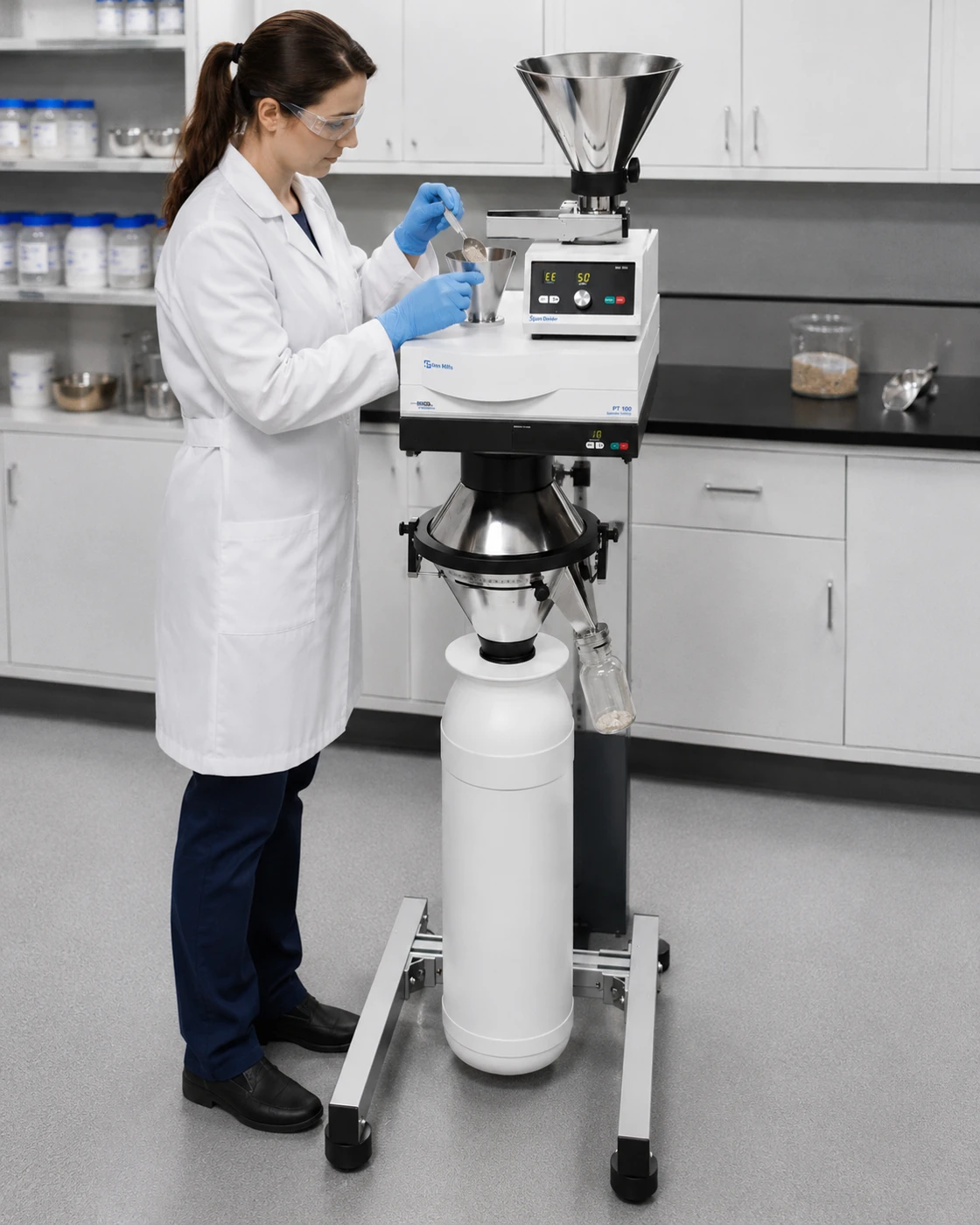
A faultless and comparable analysis is closely linked to accurate sample handling. Only a sample representative of the initial material can provide meaningful analysis results. Rotary tube dividers ensure the representativeness of a sample and thus the reproducibility of the analysis.
The rotating tube divider PT 200 is the prerequisite for dust-free division and volume reduction of larger bulk samples. It is suitable for powdered or granular bulk materials. The slot width adjusts the ratio of the fractions and therefore the amount of sample.
SAMPLE DIVIDERS
PT 200.
Rotating Tube Divider.
A faultless and comparable analysis is closely linked to accurate sample handling. Only a sample representative of the initial material can provide meaningful analysis results. Rotary tube dividers ensure the representativeness of a sample and thus the reproducibility of the analysis. The rotating tube divider PT 200 is the prerequisite for dust-free division and volume reduction of larger bulk samples. It is suitable for powdered or granular bulk materials.
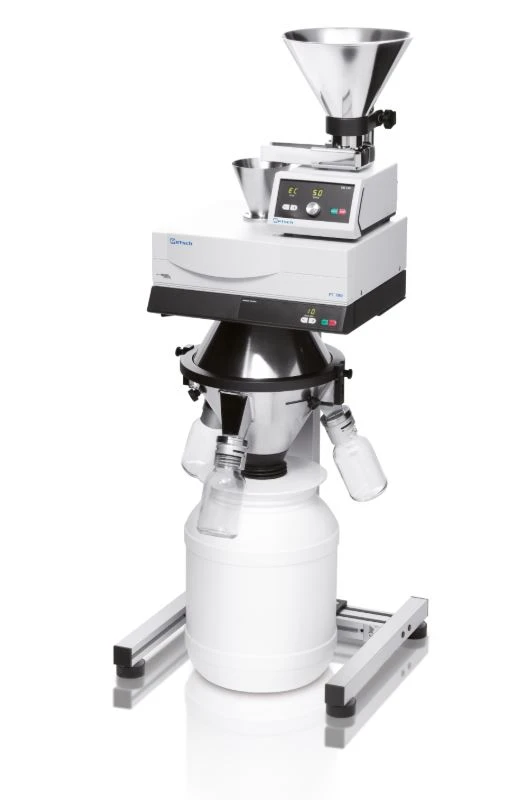
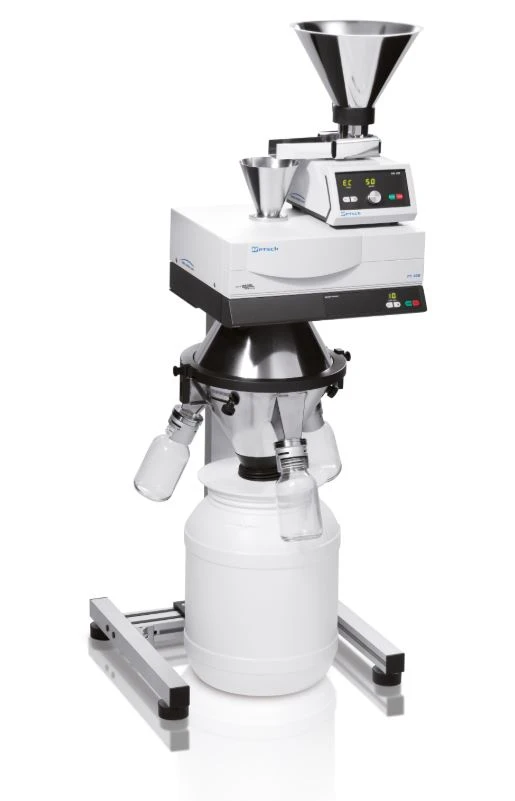
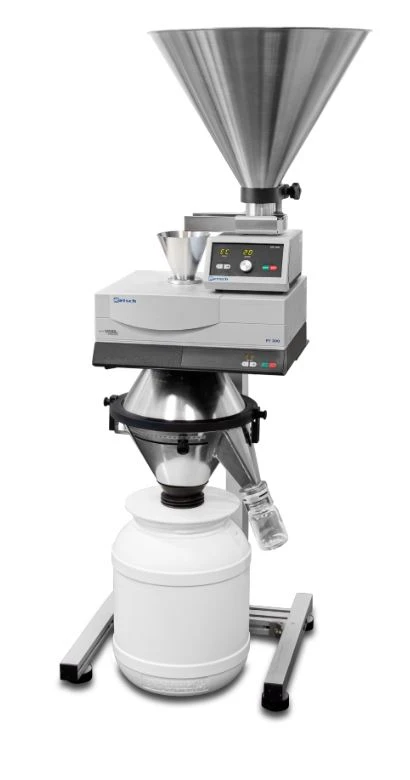
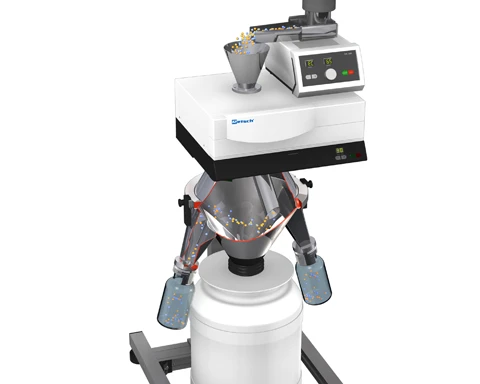
Product and configuration photographs. Select an image to enlarge.
Largest feed particle≤ 10 mm
Sample outlets1, 2 or 3, by bottom cone
Tube speed50 rpm
Reject collector26 L
THE PRODUCT IN FOCUS
Model overview
PERFORMANCE & OPERATION
Features. Operation. Handling.
PRODUCT ADVANTAGES
- exact dividing, also of larger quantities
- modular design
- adjustable dividing ratio
- extraction of 1 – 3 samples
- quick-release sample outlets and easy fastening of bottom cone
- batch and continous operation possible
- speed-controlled rotating tube
- direct digital connection for Vibratory Feeder DR 100
- dividing process according to DIN 51701
FUNCTIONAL PRINCIPLE
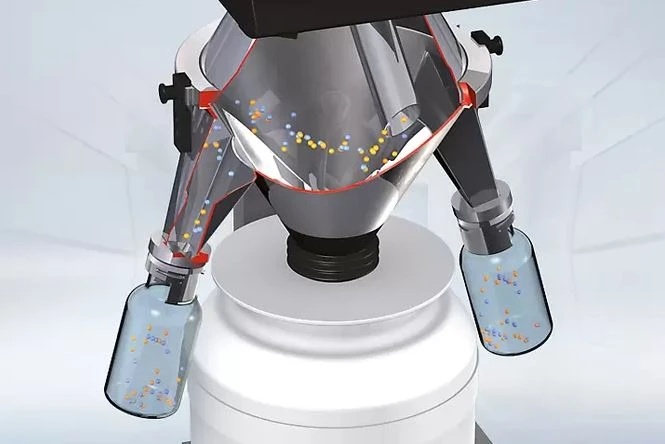
The material to be divided passes through the feed hopper via the chute of the vibratory feeder into the rotating tube divider. The total material stream is distributed evenly at a constant speed (50 min-1) over the pitch circumference of the lower cone by the tube rotating within the upper cone. The interchangeable lower cones have one, two or three continuously adjustable sample slots. In the course of each rotation a separated quantity corresponding to the width of the slot is deposited in the sample collecting vessel. The rest passes into the reject container.
TECHNICAL INFORMATION
Specifications & reference data
TECHNICAL DATA
| Applications | Sampling, sample division and sample reduction |
|---|---|
| Fields of application | Agriculture, biology, chemicals/plastics, construction materials, electronics, environment/recycling, food, geology/metallurgy, glass/ceramics and medicine/pharmaceuticals |
| Material | Powdered or granular bulk material |
| Largest feed particle* | ≤ 10 mm |
| Tube speed | 50 rpm |
| Sample outlets | 1 / 2 / 3, depending on bottom cone |
| Timer | 1, 3, 5, 10–60 minutes or continuous operation |
| Adjustable slot width | One outlet: 0–159 mm; two outlets: 0–110 mm; three outlets: 0–53 mm |
| Maximum dividing ratio | One outlet: 1 × 1:5; two outlets: 2 × 1:7.2; three outlets: 3 × 1:15 |
| Minimum dividing ratio* | 1:26 per outlet |
| Reject collector | 26 L |
| Sample containers | 250 mL / 500 mL |
| Electrical supply | 100–240 V, 50/60 Hz; single phase |
| Dimensions, W × H × D | 520 × 1050 × 551 mm; 572 × 1307 × 551 mm including DR 100 |
| Weight | Approximately 46 kg including DR 100 |
| Standards | CE |
*depending on feed material and instrument configuration/settings
YOUR MATERIAL. YOUR NEXT STEP.
Put the process
to the material test.
Tell us what you’re processing and what needs to change. We’ll help define the equipment, accessories and a useful trial.
- Material and starting particle size
- Target fineness and required quantity
- Temperature, purity and cleaning requirements