Routine small samples, flexible vessels and documented mechanochemistry methods.
Useful quantity: 2 × 20 mL · Maximum feed reference: 8 mm

MIXER MILL SYSTEMS
Grind, mix and homogenize with high-frequency impact and friction. Compare five systems for everyday sample preparation, parallel batches, ultrafine wet grinding and temperature-sensitive work.
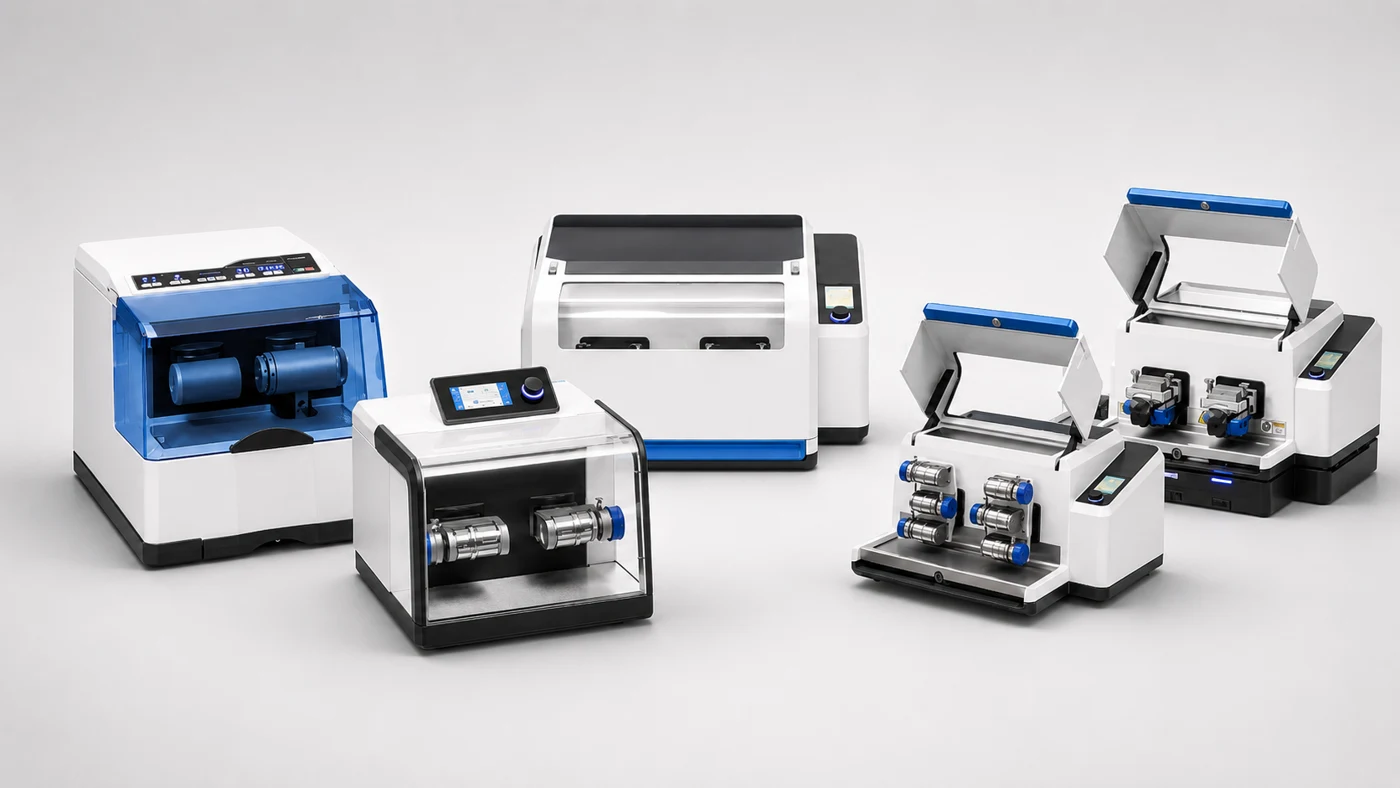
A PRACTICAL SELECTION HELPER
Choose the method first, then compare useful quantity per jar and the required number of full-size jar positions. Vial adapters can change sample counts and must be specified separately.
Routine small samples, flexible vessels and documented mechanochemistry methods.
Useful quantity: 2 × 20 mL · Maximum feed reference: 8 mm
Six grinding positions for parallel preparation and compatible reaction-vial workflows.
Useful quantity: 6 × 20 mL · Maximum feed reference: 8 mm
High-energy wet grinding and larger screw-lock jars for ultrafine research methods.
Useful quantity: 2 × 45 mL · Maximum feed reference: 10 mm
Automatic liquid-nitrogen cooling for difficult elastic or temperature-sensitive materials.
Useful quantity: 1 × 20 mL · Maximum feed reference: 8 mm
Thermal plates with an external temperature-control setup; optional cryoPad for nitrogen operation.
Useful quantity: 2 × 45 mL · Maximum feed reference: 10 mm
START WITH THE TASK
The right system depends on sample quantity, vessel format, target fineness and how temperature should be managed.
MM 400
Two-station preparation, bead beating and small research samples.
ExploreMM 500 vario
Six grinding stations and adapters for larger queues of small samples.
ExploreMM 500 nano
High-energy preparation with larger jars and a route to nano-scale particles.
ExploreCryoMill
Continuous nitrogen cooling for elastic or temperature-sensitive samples.
ExploreMM 500 control
Thermal plates with an external tempering source for monitored methods.
ExploreEXPLORE THE RANGE
Select a product for its operating principle, useful sample quantities, compatible accessories and detailed specifications.
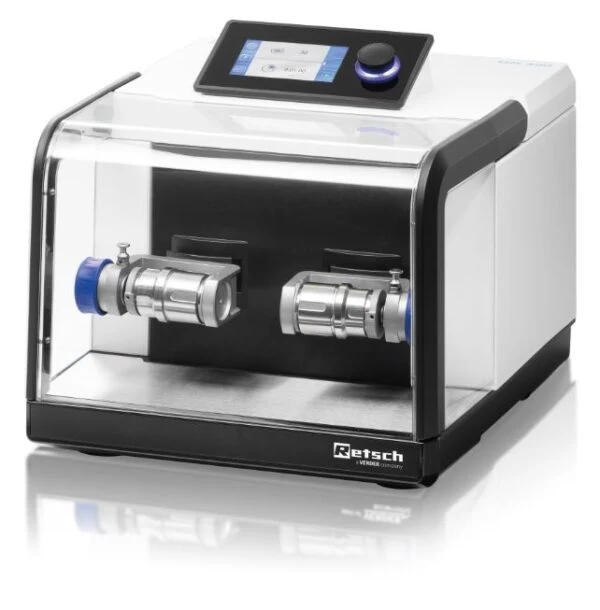
THE VERSATILE STARTING POINT
Routine preparation & flexible small samples. Manual pre-cooling with compatible steel jars.
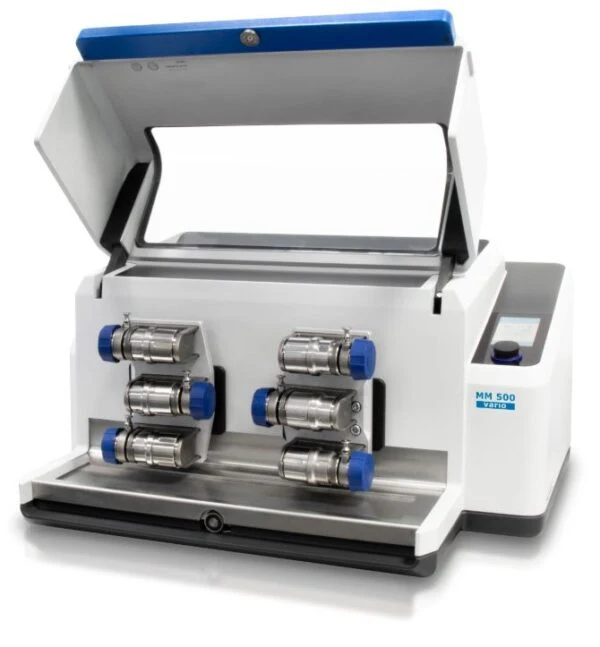
MORE SAMPLES IN EACH RUN
Parallel batches & biological sample throughput. Manual pre-cooling with compatible steel jars.
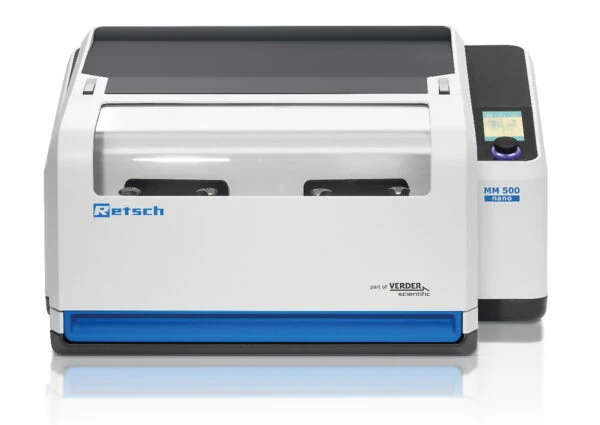
HIGH ENERGY. FINER POSSIBILITIES.
Ultrafine wet grinding & high-energy research. Manual pre-cooling; no integrated thermal plates.
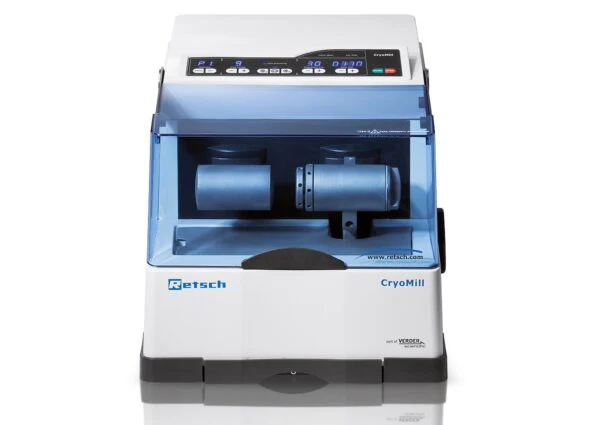
AUTOMATED CRYOGENIC PREPARATION
Automatic cooling. More useful sample preparation.. Automatic liquid-nitrogen cooling.
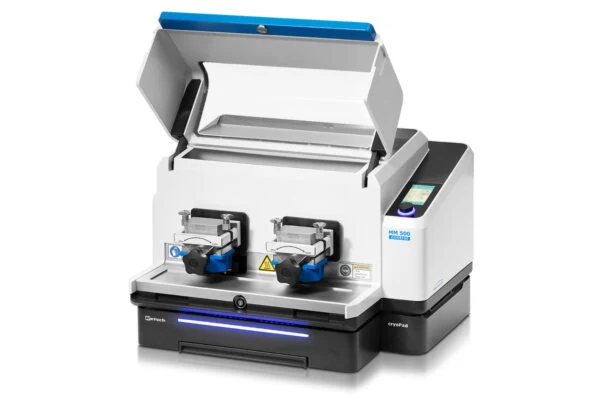
TEMPERATURE AS A PROCESS VARIABLE
Monitored heating, cooling & temperature-sensitive methods. Thermal plates; external tempering device required.
*Feed size, final fineness and useful sample quantity depend on the material, tools and operating conditions. Jar volume is not the sample filling volume. The finest result and largest feed or batch are not simultaneous guarantees.
SIDE BY SIDE
| Model | Best starting point | Feed size* | Fineness* | Frequency | Stations / sample* | Temperature approach |
|---|---|---|---|---|---|---|
| MM 400 | Routine preparation & flexible small samples | ≤ 8 mm | ~ 5 µm | 3–30 Hz | 2 / 2 × 20 ml | Manual pre-cooling with compatible steel jars |
| MM 500 vario | Parallel batches & biological sample throughput | ≤ 8 mm | ~ 5 µm | 3–35 Hz | 6 / 6 × 20 ml | Manual pre-cooling with compatible steel jars |
| MM 500 nano | Ultrafine wet grinding & high-energy research | ≤ 10 mm | ~ 0.1 µm | 3–35 Hz | 2 / 2 × 45 ml | Manual pre-cooling; no integrated thermal plates |
| CryoMill | Automatic cooling. More useful sample preparation. | ≤ 8 mm | ~ 5 µm | 5–30 Hz | 1 / Up to 20 mL | Automatic liquid-nitrogen cooling |
| MM 500 control | Monitored heating, cooling & temperature-sensitive methods | ≤ 10 mm | ~ 0.1 µm | 3–30 Hz | 2 / 2 × 45 ml | Thermal plates; external tempering device required |
*Feed size, final fineness and useful sample quantity depend on the material, tools and operating conditions. Jar volume is not the sample filling volume. The finest result and largest feed or batch are not simultaneous guarantees. On smaller screens, scroll the comparison horizontally.
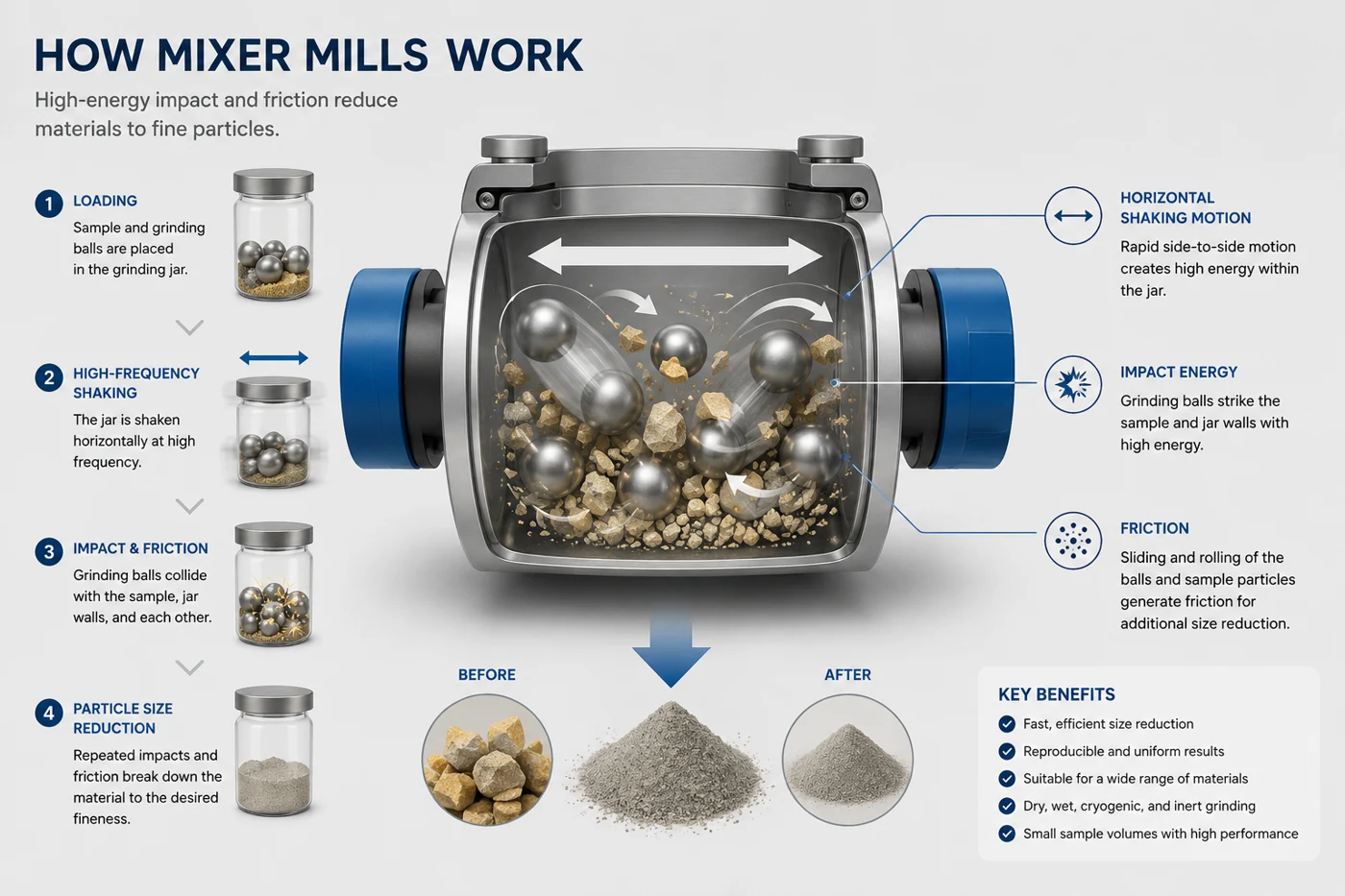
HOW MIXER MILLS WORK
Horizontal oscillation moves the jars rapidly back and forth. Grinding balls strike the material at the jar ends, while impact and friction reduce particles and mix the contents.
The method changes with the task: larger balls favor impact; smaller balls and beads increase contact and mixing. Wet grinding adds liquid and a suitable dispersing strategy. Compatible small-vial adapters support biological workflows.
SOLID-STATE & PHARMACEUTICAL RESEARCH
Explore how the MM 400 applies mechanical energy to small-sample chemical research, from repeatable reaction conditions to solid-form screening and biomass functionalization.
Use impact-driven milling, small jars and programmable methods to investigate solid-state reactions. Calibration, loading and frequency help define a repeatable experiment.
Explore MM 400 mechanochemistryCompare dry milling and liquid-assisted grinding in small steel tubes. Review the theophylline–benzamide example and its powder X-ray diffraction assessment.
Explore co-crystal screeningSee a reported example of cotton-fiber functionalization and the role of milling in developing cationic cellulose for pharmaceutical research.
Explore biomass functionalizationTEMPERATURE CHANGES THE CHOICE
MM 400, MM 500 vario and MM 500 nano can use suitable manually precooled steel jars. The method needs a plan for warming and any cooling pauses.
Learn moreCryoMill uses automatic liquid-nitrogen pre-cooling and continuous cooling during the run. Choose it when cryogenic embrittlement is the main task.
Learn moreMM 500 control couples the jars to thermal plates and an external tempering source. cryoPad is required for liquid-nitrogen operation.
Learn moreMATERIALS & APPLICATIONS
Analytical fineness, reliable homogenization, cell disruption or a mechanochemical reaction each calls for a different combination of jar, balls, vessel and method.
Choose tool materials around the analysis. Hardened steel, stainless steel, tungsten carbide, zirconium oxide and other model-specific options have different wear and compatibility considerations.
Record sample filling, ball size and quantity, frequency, duration and temperature handling. A representative trial helps establish a repeatable preparation method.
YOUR MATERIAL. YOUR NEXT STEP.
Tell us what you’re processing and what needs to change. We’ll help define the equipment, accessories and a useful trial.