Make elastic samples grindable
Continuous liquid-nitrogen cooling embrittles rubber, plastics and fibrous materials so impact and friction can reduce them more effectively.

AUTOMATED CRYOGENIC PREPARATION
Turn elastic, fibrous and temperature-sensitive samples into grindable material with automatic liquid-nitrogen cooling before and during milling. CryoMill helps preserve volatile components and also supports dry and wet grinding at ambient temperature.
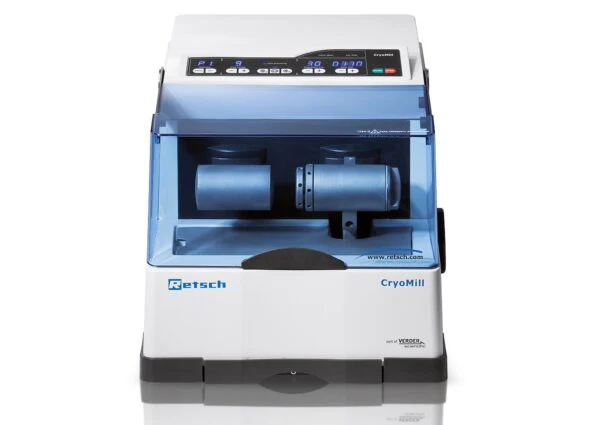
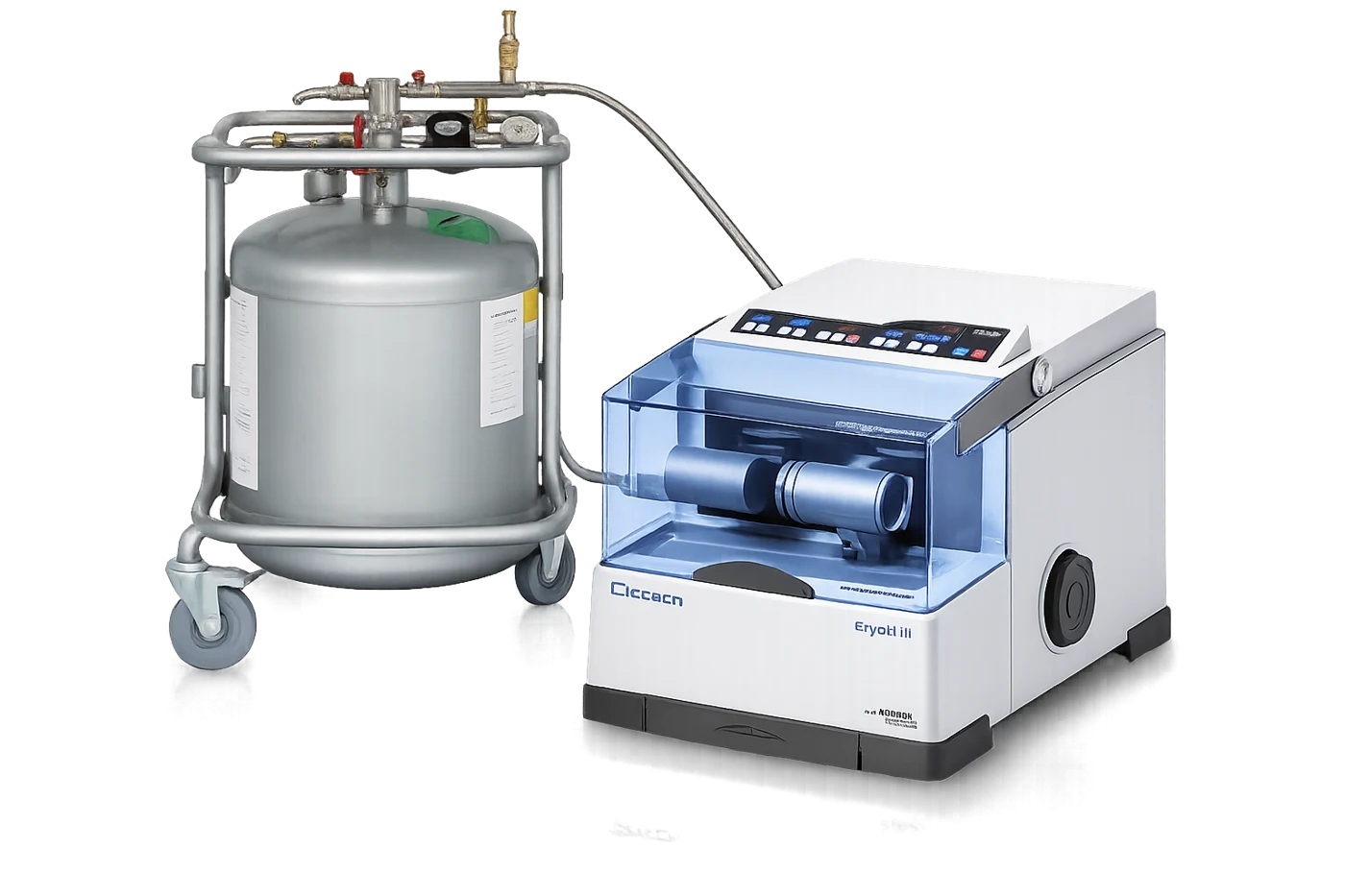
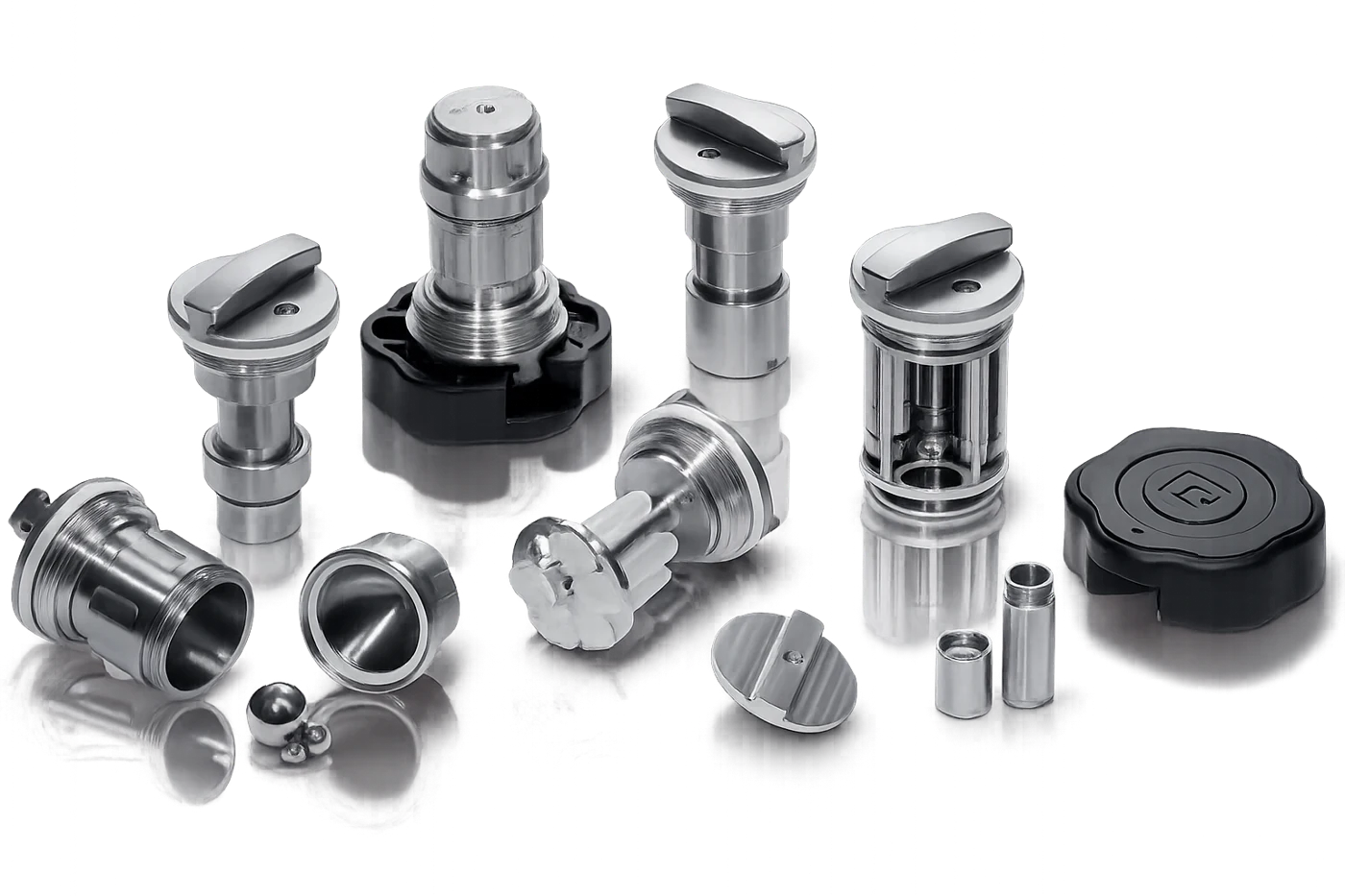
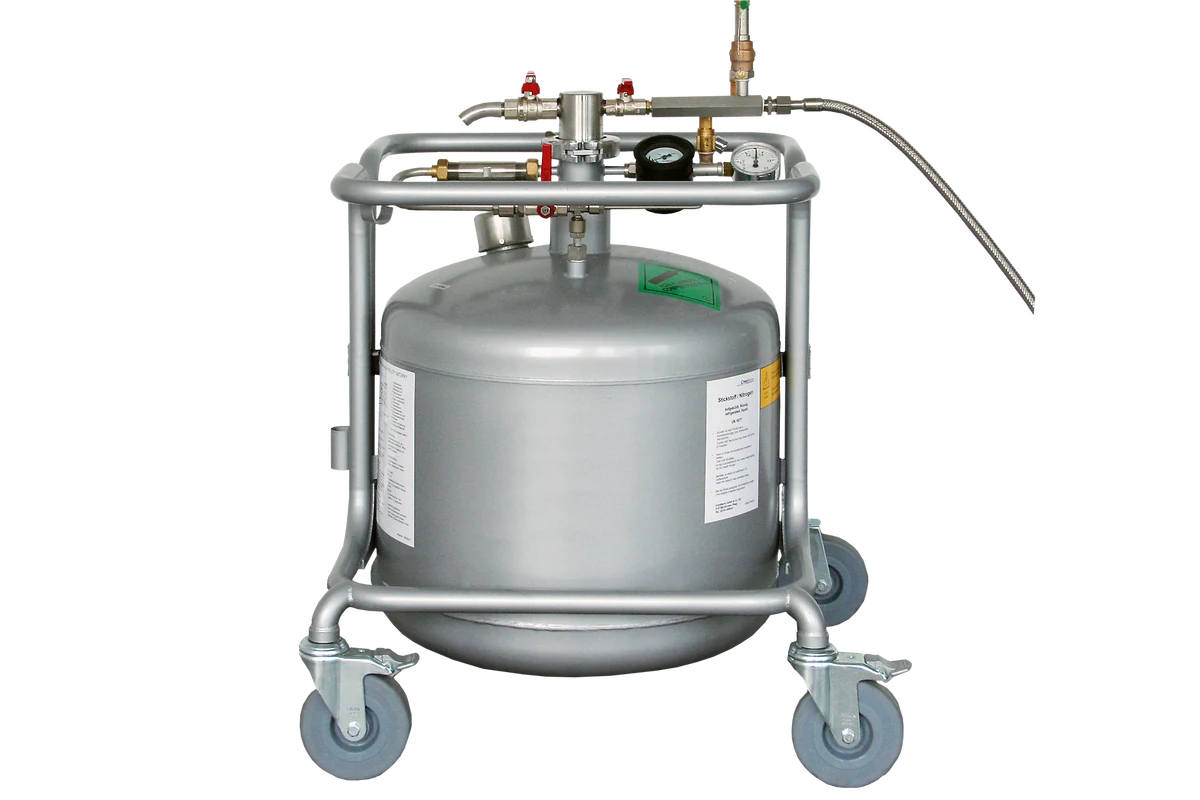
Configuration examples. Accessories may be optional.
THE MODEL IN FOCUS
Continuous liquid-nitrogen cooling embrittles rubber, plastics and fibrous materials so impact and friction can reduce them more effectively.
Cooling before and throughout milling limits warming during preparation and helps preserve volatile constituents in temperature-sensitive samples.
The automatic cycle delays milling until the required pre-cooling condition has been reached, supporting repeatable starting conditions.
Autofill delivers nitrogen through a closed cooling circuit, reducing direct handling of liquid nitrogen during the automatic process.
Nitrogen is supplied as required to maintain the cryogenic cooling condition. Intermediate cooling supports longer methods and controlled nitrogen use.
Use cryogenic grinding, or suitable dry and wet methods at ambient temperature. One compact system supports size reduction, mixing, homogenization and reaction-vial cell disruption.
HOW IT WORKS
Grinding jars oscillate in a horizontal position. The balls’ inertia drives them into the sample at the rounded jar ends. Impact and friction reduce the material while the motion mixes it.
Match ball size, number, jar material, filling level, frequency and time to the sample. Use smaller beads for compatible bead-beating methods; use a validated liquid and dispersion method for wet grinding.
Feed size, final fineness and useful sample quantity depend on the material, tools and operating conditions. Jar volume is not the sample filling volume. The finest result and largest feed or batch are not simultaneous guarantees.
METHOD & CONFIGURATION
The jar oscillates horizontally while grinding balls strike the sample. Liquid nitrogen circulates through the cooling system around the jar rather than being poured into the sample. Nitrogen at approximately −196 °C provides the cooling medium; actual sample conditions depend on the method and cooling cycle.
AUTOMATION & REPEATABILITY
Automatic cooling, digital settings and stored methods bring recurring preparation tasks into a repeatable laboratory workflow.
A clearly arranged keypad provides digital frequency, pre-cooling and grinding-time settings. Display LEDs distinguish cooling and grinding states, making the current process stage visible.
Nine SOP memories support recurring methods. Up to nine cooling and grinding cycles can be programmed, including intermediate cooling for longer preparations. Parameters remain available during standby.
A single self-centering clamping station accommodates screw-top jars and small-sample adapters. The benchtop format combines cryogenic preparation with ambient dry or wet milling.
CLOSED AUTOMATIC COOLING
Liquid nitrogen cools the grinding jar through the integrated cooling system before and during milling. The automatic sequence first establishes the cooling condition, then maintains it during processing.
The nitrogen cooling reference is approximately -196°C. Cooling performance and actual sample conditions depend on loading, tools and the method. Intermediate cooling can be incorporated when an application needs a longer sequence.
The closed system reduces direct nitrogen handling during the automatic cycle. Installation, supply and laboratory cryogenic provisions remain part of the complete configuration.
APPLICATION BENEFITS
Material behavior and the downstream analysis determine the method. The listed feed range includes hard, medium-hard, soft, brittle, elastic and fibrous samples.
Cryogenic embrittlement helps elastic and fibrous materials fracture. Examples include plastics, rubber, textiles, wool, paper and wood.
Low-temperature preparation supports suitable oily seeds, feed, plant material and tablets, including samples where warming or volatile loss would affect analysis.
Applications include tissue, hair, bone, soil, sludge and waste. The reaction-vial adapter also supports compatible small-sample cell disruption methods.
BUILD THE RIGHT SETUP
Select jars, balls and supporting accessories around your material and analysis. Confirm the complete configuration and what is included in the quotation.
One self-centering grinding station accepts 10, 25, 35 or 50 mL jars. An adapter accommodates four 5 mL jars; another holds six 2 mL reaction vials. Screw-top closures support leak-resistant processing. Nominal vessel volume differs from useful sample quantity.
An optional 50 L supply container supports approximately five hours of cryogenic grinding, depending on the method. A compatible existing cryogenic tank can be connected using the specified connection tube and safety-valve arrangement.
Tool materials include hardened steel, stainless steel, zirconium oxide and PTFE. A 25 mL zirconium oxide jar with matching balls, available in a cryogenic-compatible design, provides an option where steel-related contamination matters; PTFE jars are also available. Confirm the material, jar size and grinding mode together.
MATERIALS & APPLICATIONS
TECHNICAL DATA
| Grinding stations | 1 |
|---|---|
| Maximum feed size* | ≤ 8 mm |
| Final fineness* | ~ 5 µm |
| Useful sample quantity* | Up to 20 mL |
| Nominal jar volume | 5, 10, 25, 35 or 50 mL; adapters depend on format |
| Vibrational frequency | 5–30 Hz |
| Temperature approach | Automatic liquid-nitrogen cooling |
| Feed material | hard, medium-hard, soft, brittle, elastic, fibrous |
|---|---|
| Size reduction principle | impact, friction |
| Material feed size* | <= 8 mm |
| Final fineness* | ~ 5 µm |
| Batch size / feed quantity* | max. 20 ml |
| No. of grinding stations | 1 |
| Vibrational frequency | digital, 5 – 30 Hz (300 – 1800 min-1) |
| Typical mean grinding time | 10 min / 4 min (cooling / grinding) |
| Dry grinding | yes |
| Wet grinding | yes |
| Cryogenic grinding | yes |
| Cell disruption with reaction vials | yes |
| Self-centering clamping device | yes |
| Type of grinding jars | screw top design |
| Material of grinding tools | hardened steel, stainless steel, zirconium oxide, PTFE |
| Grinding jar sizes | 5 ml / 10ml / 25 ml / 35 ml / 50 ml |
| Autofill | 50 l |
| Setting of grinding time | digital, 30 s – 99 min |
| Storable SOPs | 9 |
| Electrical supply data | 100-240 V, 50/60 Hz |
| Power connection | 1-phase |
| Protection code | IP 30 |
| Power consumption | 260 W |
| W x H x D closed | 395 x 373 x 577 mm (D: 710 mm with exhaust tube) |
| Net weight | ~ 45 kg |
| Standards | CE |
*Feed size, final fineness and useful sample quantity depend on the material, tools and operating conditions. Jar volume is not the sample filling volume. The finest result and largest feed or batch are not simultaneous guarantees.
EXPLORE THE FAMILY
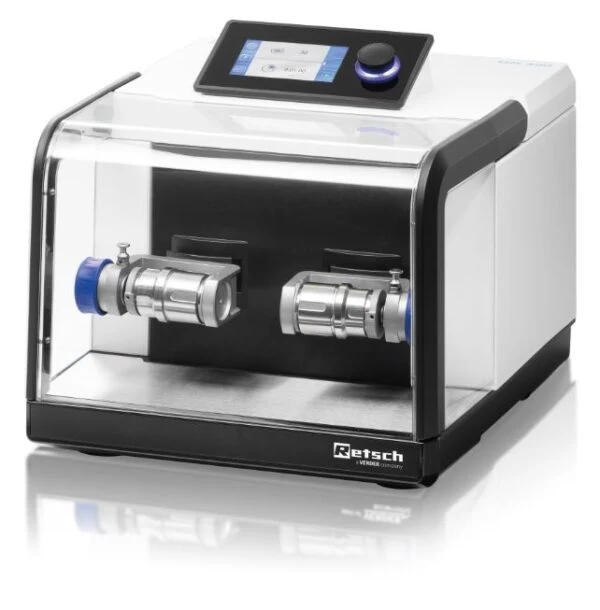
Routine preparation & flexible small samples
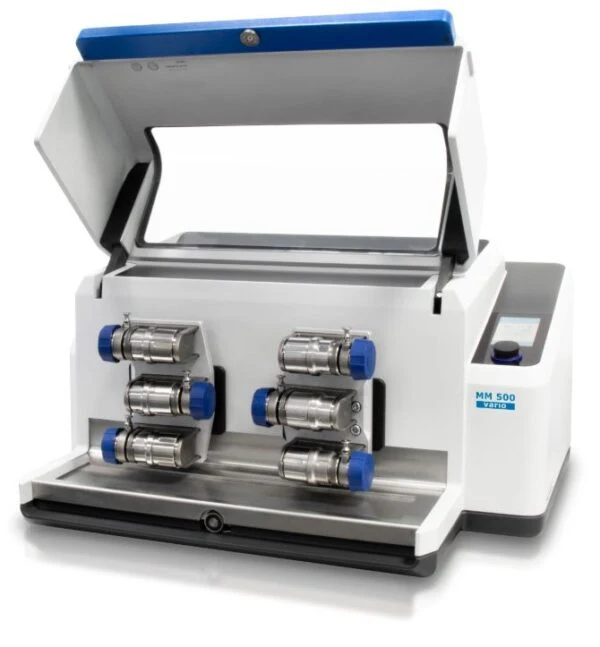
Parallel batches & biological sample throughput
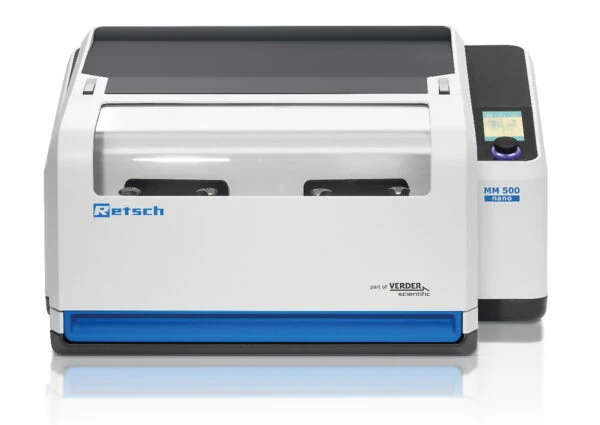
Ultrafine wet grinding & high-energy research
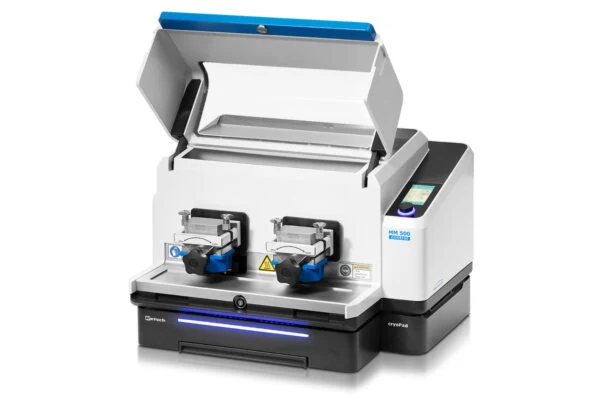
Monitored heating, cooling & temperature-sensitive methods
YOUR MATERIAL. YOUR NEXT STEP.
Tell us what you’re processing and what needs to change. We’ll help define the equipment, accessories and a useful trial.